Bernardo Caldas, Director of Data and AI, Mollie
Bernardo Caldas discusses Mollie's AI-driven commerce vision, the shift to agentic commerce, and why open ecosystems will define the future of fintech.
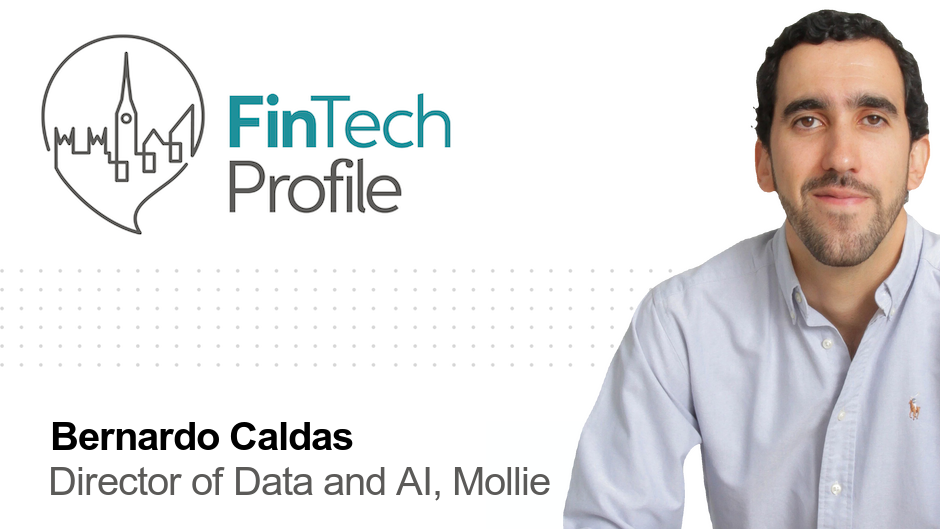
Today we're delighted to speak with Bernardo Caldas, Director of Data and AI at Mollie, one of Europe's fastest-growing financial service providers. As a Machine Learning Engineer who's passionate about AI-driven commerce, Bernardo shares his insights on the shift towards agentic commerce, the balance between friction and trust, and why traditional banks need to embrace open ecosystems or risk being left behind.
Right, let's get started.
Over to you Bernado - my questions are in bold:
Who are you and what's your background?
I'm originally from a small town in Portugal, though I'm currently based in Lisbon. At heart, I'm a total geek – specifically, a Machine Learning Engineer fascinated by the power of having machines derive patterns and learn from our data.
My academic journey began with Electrical Engineering here in Lisbon, but my path really shifted when I moved to the UK to study Machine Learning and Neural Computation at Imperial College London. That is where I truly fell in love with everything AI-related.
Since then, my career has been driven by a love for industries rich in granular data – places where data reflects how the world works, allowing us to get to know it better and make it work better. Before Fintech, I worked in Telecommunications, analysing the data of how people communicate.
I eventually got into the Fintech arena by simply 'following the data trail'. I view Fintech as the study of how the economy communicates. It offers deep insights into how consumers make choices and how companies operate and grow, making it a super challenging but incredibly interesting domain.
What is your job title and what are your general responsibilities?
I am the Director of Data and AI. My role oversees both our internal and external usage of data and AI.
Internally, I lead the teams responsible for our data platform, analytics, data governance, and machine learning. My goal is to get our data into a state where it is immediately useful for everyone across the business. This means enabling teams to clearly understand what is happening with our customers and our business today, while also predicting future trends and automating processes by leveraging the power of our scale.
Externally, my focus is on generating value for our merchants by leveraging our data and AI capabilities for them. It is about using our expertise to power insights that help them grow faster. A significant part of this is spearheading Mollie's development in AI-enabled commerce, ensuring we fit into the wider AI ecosystem – whether through our MCP server or Agentic Commerce initiatives.
Can you give us an overview of your business?
Mollie is a fast growing financial services platform that helps businesses across Europe get paid and manage their money effortlessly: online, in person, and across borders. With a single, powerful integration, companies can accept payments, streamline reconciliation and reporting, prevent fraud, and access flexible financing to fuel their growth.
Through Mollie Connect, SaaS and platform partners can embed payments directly into their products and unlock new revenue streams.
Today, over 250,000 businesses, from fast‑growing startups to large enterprises rely on Mollie's hyper‑local solutions in 30+ European markets, supported by local payment methods, multi‑language support and integrations with local business software solutions.
Founded in 2004 in Amsterdam, Mollie's mission is to make payments and money management effortless for every business in Europe and beyond.
Tell us how you are funded?
Our founder is very special: he started building Mollie's backend software when he was just 18 and still living with his parents in Amsterdam. Since those early days, the company has grown tremendously – in 2021, we raised €665 million (£553 million), reaching a valuation of €5.4 billion (£4.5 billion). That round was led by Blackstone Growth and supported by EQT Growth, General Atlantic, HMI Capital, Alkeon Capital, and TCV.
Who are your target customers? What's your revenue model?
We work mainly with ecommerce businesses, online retailers, subscription services, and other companies of all shapes and sizes. Our clientele includes the likes of Fireaway Pizza with whom we work for online and in-person payments, Gymshark, Tails.com, Soak&Sleep, Mazda, and Wild Cosmetics, to name a few.
We use a transaction-based revenue model, where we charge businesses a fee for each payment processed through the platform. There's no setup or monthly subscription fee, which means businesses only pay for what they use. This way it's easy for companies to scale without worrying about long-term commitments. For some features, like advanced fraud protection, we might add extra charges, but our core offering is focused on simple and transparent payment processing.
If you had a magic wand, what one thing would you change in the banking and/or FinTech sector?
One thing I'd love to see change in fintech is the tendency for customer support to feel transactional or impersonal. When merchants run into issues, they need fast, practical guidance – not just generic responses. This is especially important for small and medium sized businesses.
That is exactly why we've made support a real priority at Mollie. That said, our Trustpilot rating of 4.6 stars from over 9,000 reviews reflects how seriously we take this. We always aim to provide clear, actionable help so businesses can keep moving without unnecessary delays.
What is your message for the larger players in the Financial Services marketplace?
Don't underestimate the speed of the shift that is coming. We are moving from a world where customers log in to check balances, to a world of 'Agentic Commerce' where machines transact on behalf of humans.
We are already building the AI-native rails for this future. If your strategy is still focused on building proprietary 'walled gardens' rather than open, interoperable ecosystems, you are going to find yourselves locked out of the next economy. The future is open, real-time, and AI-driven, so catch up or get left behind.
Where do you get your Financial Services/FinTech industry news from?
I'm a big fan of Fintech Brainfood by Simon Taylor. He is one of the few writers who actually understands the technical layer, rather than just the business side.
Can you list 3 people you rate from the FinTech and/or Financial Services sector that we should be following on LinkedIn, and why?
- Simon Taylor: As I mentioned, he is a solid source for deep dives into the industry.
- Marcel van Oost: He is simply a great source for European fintech news. He does an excellent job of curating the most relevant updates across the ecosystem, making him an essential follow for anyone who wants to stay plugged into the market.
- Adriaan Mol, the founder of Mollie: He approaches fintech with a product-first mindset rather than a banking one. Following his work gives you a good sense of how we are trying to build things differently.
What FinTech services (and/or apps) do you personally use?
I'm a big believer in 'dogfooding', so I use Mollie constantly to see how our own product evolves.
What's the best new FinTech product or service you've seen recently?
It's not a single app, but rather a new capability: the emergence of autonomous buying agents (Agentic Commerce).
We are starting to see the first real examples of AI that can not only recommend a product but actually navigate a checkout flow and execute the purchase on behalf of the user. Seeing this shift from 'chatbots' to 'action-bots' is the most exciting development in fintech right now because it validates what we are building: the infrastructure for machine-to-machine commerce.
Finally, let's talk predictions. What trends do you think are going to define the next few years in the FinTech sector?
I see two major themes defining the next few years.
- First, the battle between friction and trust. There is a continuous push for frictionless consumer experiences, but the real challenge is achieving that while maintaining absolute safety. As AI and Agentic Commerce start to play a bigger role, we will face entirely new fraud patterns. The winners in this space will be those who can be 'smart' about optimizing the journey while being excellent at detecting fraud. Finding this balance is critical and requires a very strong tech & AI foundation.
- Second, I expect a move towards 'extreme simplification' for merchants. Right now, running a business involves juggling too many different financial providers. The sector is still far too complex. We are going to see a shift toward deeply integrated ecosystems – like what we are building with Mollie Capital and Business Accounts – where financing, banking, and payments live in one place. The goal is to simplify financial services to the extreme so merchants can focus on growth, not admin.
Thanks to Bernardo for taking the time to share his insights with us.
To learn more about Mollie and their AI-driven approach to payments, visit their website.