Anthony Hynes, Executive Chair, EML Payments
Anthony Hynes discusses EML Payments' transformation strategy, tackling financial exclusion, and why the future of B2B payments lies in end-to-end integrated workflows.
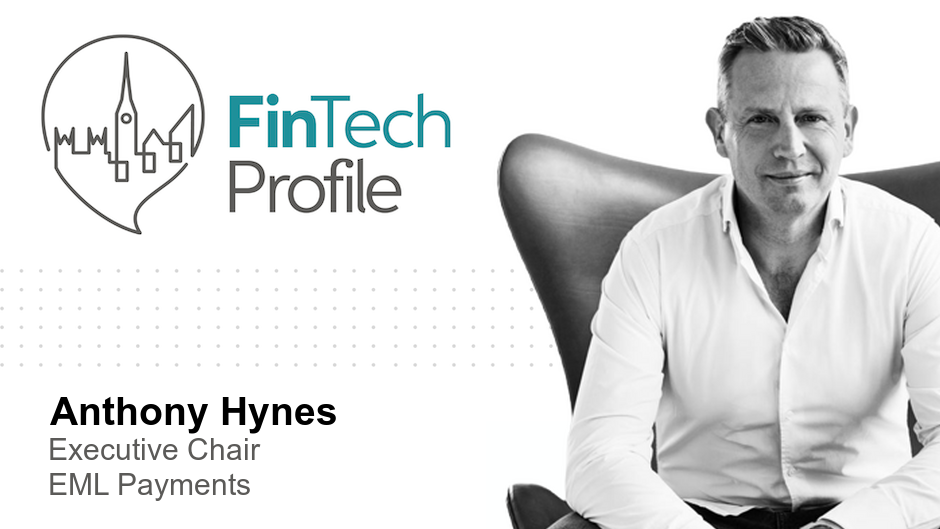
Today we're delighted to speak with Anthony (Anth) Hynes, Executive Chair of EML Payments. With over 25 years in B2B payments, Anthony has built and scaled multiple payment businesses including eNett International, which processed tens of billions in annual payment volume before its acquisition by WEX Inc. Now leading EML's ambitious transformation strategy, he shares insights on simplifying complex payment flows, addressing financial exclusion, and why fragmentation remains the biggest challenge in the payments sector.
My questions are in bold - over to you Anthony:
Who are you and what's your background?
I'm Anthony Hynes (Anth), Executive Chair of EML Payments. I've spent more than a quarter of a century in B2B payments, building and scaling businesses by fixing things that I know can work better.
My interest in payments started during my MBA, when I began looking closely at how money actually moves. While analysing a telco bill payment flow, it became obvious just how fragmented and inefficient the system was. The opportunity wasn't about incremental improvement - it was about redesigning the flow.
That thinking led to the co-founding of PSP International in 2003, which later was renamed Optal, one of Europe's leading virtual card issuers. Soon after, a hotel group's need to automate supplier payments and reconciliation sparked the launch of eNett International - a company that scaled quickly because it addressed a real problem at real volume.
Within a few years, we had built a virtual card-based B2B payments platform that fundamentally changed how payments worked across the global travel value chain. I led the business for more than 12 years, growing it to tens of billions of dollars in annual payment volume, before eNett and Optal were acquired by WEX Inc. in 2020.
Today at EML, I'm applying the same principles that have guided my career: simplify the flow, remove friction, and build end-to-end payment capability that works for customers. I am leading the company's ambitious transformation strategy, with a vision to position the company to reimagine what payments can be - pairing rigour with ingenuity to create new value for our clients and their customers around the world.
What is your job title and what are your general responsibilities?
The title is Executive Chair, but the role is less about the official title and more about leading EML's vision and building momentum.
Culture is incredibly important to me as we look to transform and scale rapidly, which is why I place so much emphasis on empowering my team, building trust and bringing expertise to the table.
That said, I was brought on as Executive Chair to see the business through its next stage of transformation – our EML 2.0 strategy. Historically, EML has served multiple market segments without one unified payment offering. We've been focused on building a clear strategy and transformation plan, enhancing our leadership team, and improving operational efficiency. I work closely with customers, partners and stakeholders to steer them towards game-changing payment solutions, compounding growth and exceptional value.
Our new platform allows us to do so much more and reach new verticals including mobility, expense management and travel. It's been designed to cater to each client's need across a wide range of sectors, and I am laser focused on scaling that offering every day.
Can you give us an overview of your business?
EML Payments is a listed payments company delivering instant, secure payment solutions for enterprises, corporates and governments. We operate across 27 countries, including the UK, Europe, Australia and North America, and generated $221m in revenue this last financial year.
Our platform supports a wide range of use cases. In the public sector, we help governments distribute funds quickly and transparently. In the UK, for example, we work with local councils across more than 19 different disbursement types to ensure essential support reaches people when it's needed.
For businesses, we enable controlled, purposedriven payments - from employee reward and benefit programmes and gift cards to expense and payrolladjacent solutions. Fintechs and platforms also use our issuing and payment rails to embed payments directly into their own products.
In the consumer sector, we partner with major retail brands and multinational shopping malls to deliver high-impact gift card programs that drive customer spend and brand loyalty.
Across all of this, the common thread is control, visibility and speed — payments that are built into workflows, not bolted on.
Tell us how you are funded?
We are a publicly listed company traded on the Australian Securities Exchange.
What's the origin story? Why was the company started? To solve what problems?
EML was founded in 2011 with a vision to simplify payments through prepaid solutions. We started by launching single-use and multi-use prepaid cards, providing individuals and businesses with secure, flexible payment options. We then grew our footprint to include the US and Canada.
Building on success in prepaid cards, we embarked on the next phase of innovation in 2016 with the introduction of digital wallet services. This expansion opened up new possibilities for mobile rewards, payments, acceptance controls, and just-in-time funding.
In 2022, we took a significant step forward by shifting to a cloud-based platform. This move allowed us to offer a unified enterprise solution that integrated digital wallets with real-time payments capabilities.
The future will see us move beyond incremental growth and unlock the full potential of EML by expanding into new verticals, territories and markets.
Who are your target customers? What's your revenue model?
Our target customers range from governments needing disbursement solutions, employers seeking best in class, flexible rewards programs for their staff, retail brands seeking to implement gift and incentive programs, to financial institutions looking for innovative payment technologies and medium to large businesses requiring streamlined expense management tools.
In the UK, we recognise that one of the key areas ripe for payments disruption is the pre-paid card sector in support of financially vulnerable individuals. We partner with the likes of Fair For You to empower the financially disadvantaged through a prepaid card programme that breaks down barriers to financial participation for those traditionally excluded from mainstream credit.
Through an affordable and ethical prepaid Mastercard solution, financially vulnerable families gain access to essential goods and services without the risks of high-cost or predatory lending, helping customers manage debt responsibly.
Elsewhere, we target businesses looking for innovative payroll solutions. We work with Dayforce Wallet to enable employees to access their wages in real time, providing a flexible and financially empowering tool for the modern workforce. For employers with a seasonal or transient workforce, earned wage access allows them to pay their employees immediately without having to wait for payroll set up, while it also removes any cash requirement, mitigating the risks associated with distribution of cash.
These are just two examples of where our offering falls into part of a much broader mission for us: tackling the root cause of financial exclusion and building long-term resilience in low-income communities.
While the use cases differ, the model is consistent. We provide the infrastructure that sits underneath, enabling secure, compliant and scalable payments at volume.
If you had a magic wand, what one thing would you change in the banking and/or FinTech sector?
The problem is fragmentation - this still defines the B2B payments sector.
Too many businesses are forced to stitch together multiple providers just to get a complete view of their payments. That creates friction, cost and risk.
The future is endtoend integrated workflows. Payments that sit inside the operating model and mirror how they operate day to day, not alongside it. Providers that can combine issuing, processing, settlement, controls, reporting and automation into a single ecosystem will win.
In today's world where demand for custom solutions that can be easily integrated into existing systems, the winners will be those who bring together end-to-end workflows, not isolated tools. Raising the bar to create this experience should be the ultimate aim of providers
Where do you get your Financial Services/FinTech industry news from?
Financial Times, CNBC, and the Australian Financial Review.
Can you list 3 people you rate from the FinTech and/or Financial Services sector that we should be following on LinkedIn, and why?
- Jack Zhang from Air Wallex because it's a great Australia success story and is the epitome of what is possible if you surround yourself with smart people and are aligned around the vision.
- Marcel van Oost's Connecting the Dots in Fintech newsletters for quick industry insight
- Carlo Gualandri, CEO at Soldo for peer insight and entrepreneurial content
What FinTech services (and/or apps) do you personally use?
ApplePay everyday, Apple Wallet most days, banking apps, authentication apps and card apps such as Amex.
What's the best new FinTech product or service you've seen recently?
American Express is setting the pace for innovation across mobile banking, surpassing many traditional banking apps I've seen to date. Its seamless, integrated payments ecosystem not only delivers a best-in-class customer experience, but also positions itself as a leader in travel payment innovation.
The flexible and intuitive use of rewards at Amex, such as through its travel redemptions and everyday gift card incentives, demonstrates an innovative loyalty experience that is embedded as a key part of the payments experience. Combined with more personalised and smarter digital tools, it is a player that stands out in the market.
We're also busy working on a new platform that encapsulates the same seamless payments architecture, but more on that to come later this year.
Finally, let's talk predictions. What trends do you think are going to define the next few years in the FinTech sector?
B2B payments are sitting on a massive amount of underused data. The next wave of innovation will come from turning that data into realtime intelligence: automating decisions, managing risk earlier and improving working capital outcomes.
At the same time, platforms will continue to consolidate. Customers don't want more tools. They want fewer, better ones that actually work together.
Momentum will come from execution not hype. The teams that stay close to customers and keep solving real problems will pull ahead.
Thank you for taking the time to speak with us Anthony. You can connect with him on LinkedIn and learn more about EML Payments on their website.