Anette Broløs, Director and Co-Founder, Finthropology
Anette Broløs discusses how qualitative research and human insights can transform financial services, making them more customer-centric and inclusive.
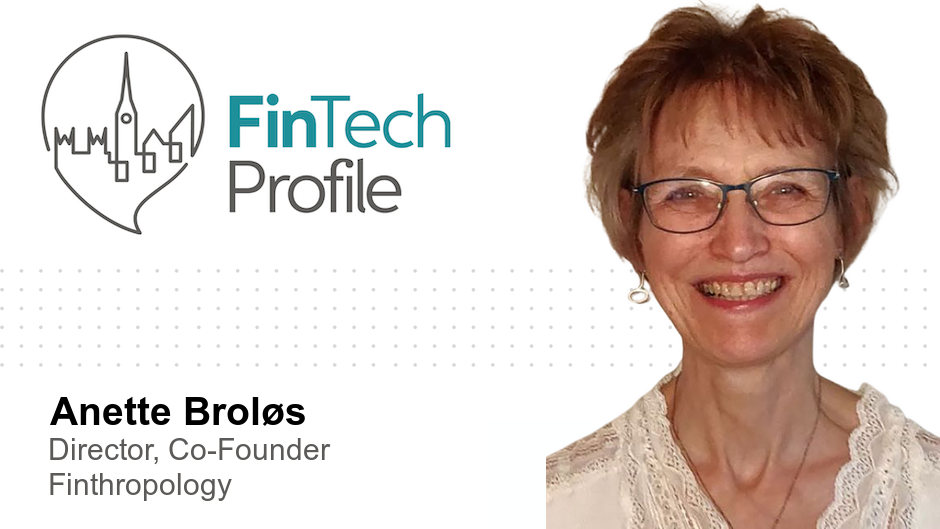
Today we're delighted to feature Anette, Director and Co-Founder of Finthropology, a consultancy that delivers human insights for finance based on state-of-the-art qualitative research.
With a background spanning economics, innovation, and collaborative research, Anette brings a unique perspective on why financial institutions need to look beyond quantitative data to truly understand their customers' behaviour and needs.
My questions are in bold - over to you Anette:
Who are you and what's your background?
I am a fintech analyst working with strategy and innovation. I am based in Denmark and raised my three children here. I share the joy of horseback riding with my husband and daughter. My background is in economics with a Master's degree from the University of Copenhagen and an e-MBA from Copenhagen Business School. I did part of my Master's in France. I worked for many years in finance in different capacities, but always with innovation, and most often in the space between finance and technology. This inspired me to do my industrial PhD in collaborative innovation at the University of Southern Denmark, working with a regional bank and a datacentre. When fintech started developing I was the CEO of Copenhagen Fintech Innovation and Research, bringing finance, technology and research together to build common ground for development for existing players, as well as for the young startups. This is also where I started building my experience as a conference speaker and moderator – and later as an author.
What is your job title and what are your general responsibilities?
My job title is Director and Co-Founder. In a small company like ours, we share in both research, customer contact and practical activities. My main work involves data collection and analysis, report writing and dissemination. My partner, Dr. Erin B. Taylor, is an anthropologist and undertakes most of the fieldwork – but I very much enjoy the interviews and observations that come with qualitative studies – and the often surprising insights they bring.
Can you give us an overview of your business?
Finthropology helps clients understand peoples financial behaviour and become more customer centric. We apply our cutting-edge knowledge of human behaviour to help create successful financial products, programmes and policies for a human world. We mostly undertake qualitative studies built on observations, interviews, digital ethnography etc. These methods provide strong insights on WHY and HOW people make decisions to supplement the learnings from quantitative studies on how many and how much. We have studied financial services targeted at women like Ellevest, Nav.it and many more and we have prepared a report on Americans' adoption of Buy-Now-Pay-Later. Our methods allow us to understand not only current customer preferences but also to point to what might be important in the future - as in a large study on the potential for CBDC's in Brazil. You can find most of our work at our website.
Tell us how you are funded?
We have chosen to be self-funded, providing us with independence and freedom of choice. We were lucky enough to start the business with a large five-year study to secure a basic income. And our work does not require much capital – except for the larger field studies, which are most often client-funded.
What's the origin story? Why did you start the company?
We connected at a conference and realised that we both felt that many financial companies overlook the need for research, research collaboration and particularly the need to understand customers. The ongoing and increasing financial focus on customer centricity is sadly too often and too extensively founded only in the use of quantitative data. There are so many examples of how this overlooks large customer groups and misinterprets customer actions - overlooking the use of work-arounds or decisions made in communities. Finthropology helps provide these surprising insights that help companies and institutions develop better services.
Who are your target customers? What's your revenue model?
We work for a variety of customers including universities, NGOs, independent research institutions and companies. Our revenue model is simple in the sense that we do paid research with clients paying for a combination of direct cost, our work and the resulting reports. So far it has been possible to offer access to our research for free.
If you had a magic wand, what one thing would you change in the banking and/or FinTech sector?
That both traditional players and fintechs would be open to experiment with research based on qualitative data and to use the potential that digital technology has to interact with customers and learn about why their services are chosen (or not) and how they are used.
What is your message for the larger players in the Financial Services marketplace?
You already have great financial and technological knowledge and resources. Think about how working with your customers to turn product development round from inside out to outside in. You might learn how the next generation of customers expect their gaming and shopping experiences to connect, how your customers feel about credit scores and data privacy or just how and why they switch between numerous different payment solutions.
Where do you get your Financial Services/FinTech industry news from?
This is tricky because extensive international news subscriptions are expensive for a small company like ours leading to a number of insightful newsletters like Finextra, Fintech Futures, Harrington Star, La Place Financière, news from European Women Payments Network (EWPN) and many more.
Can you list 3 people you rate from the FinTech and/or Financial Services sector that we should be following on LinkedIn, and why?
- Dave Birch, whose knowledge and analytical powers in payments and identity are supported by the ability to share thought provoking comments and presentations.
- Barbara Stewart whose research in female investment is opening the field to completely new ways of understanding investment terminology and services.
- Malin Lignell – you should be aware of her work with future thinking and scenarios something that is too often overlooked in finance.
What FinTech services (and/or apps) do you personally use?
Fewer than you might think. I definitely use the mobile apps and interfaces provided by my general providers – and as a Dane I very often use Mobile Pay, the general payment solutions.
What's the best new FinTech product or service you've seen recently?
From a practical perspective I would mention the secure digital onboarding and signature solutions. For a concrete example of a service pointing to new ways of combining finance, inclusion and new technological infrastructure I would like to point you to GoodDollar.
Finally, let's talk predictions. What trends do you think are going to define the next few years in the FinTech sector?
There is no doubt that AI and the introduction of CBDCs will play an important part. And that finance will increasingly be integrated in other solutions like payments in online gaming, BNPL or social media. This means that while we have long discussed the size of banking interest rates and fees, we will increasingly have to discuss the price of data sharing in alternative business models including the price of lock-in with some solutions providers. From a behavioural perspective it will be interesting to see how much interest the potential of decentralised finance will attract. And at the society level how governments worldwide will consider building financial intermediation for the future.
Thank you to Anette for sharing her insights with us. To learn more about Finthropology's work in qualitative financial research, visit their website or connect with Anette on LinkedIn.