Ali Hood, Founder & CEO, Recirculate Systems
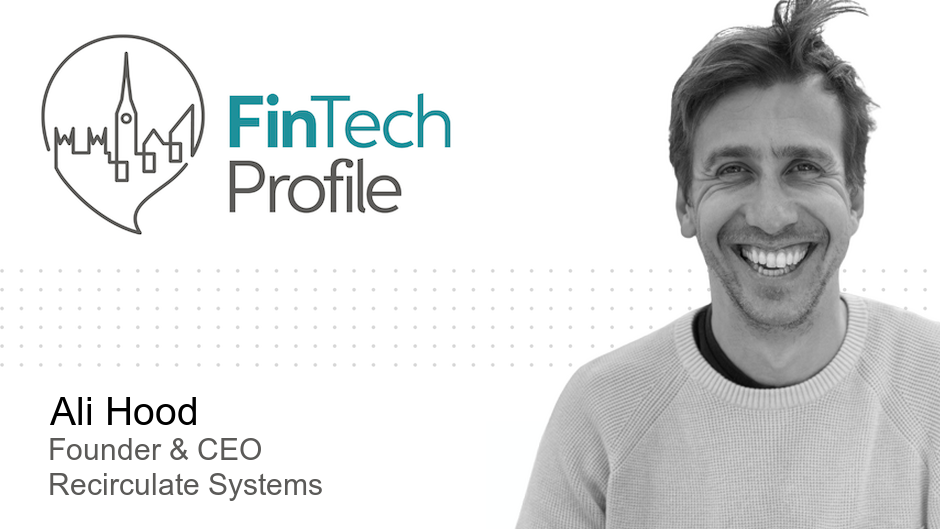
Today we're meeting Ali, Founder & CEO at Recirculate Systems. They specialise in software that can help manage the circular economy and has the potential to eliminate single-use plastic from coffee shops, sports events and more, globally. Over to you Ali - my questions are in bold:
Who are you and what's your background?
Hi, I'm Ali and I guess in the simplest terms I like making stuff work; both physical stuff and also in businesses, in terms of having an idea and bringing that to fruition, or seeing a problem and trying to solve it. I started my career in waste project management because I've always been an environmentalist. In fact, I got into trouble at school for stealing a load of spelling books to make membership cards for a 'green' club that I started, where I convinced my friends to take on green initiatives like picking up litter and saving water. From there I was always in trouble for something that had a business element to it, like selling things or running a tuck shop. After university, I got into project management in the environmental space and then, with that experience, joined the British Museum where I oversaw the temporary exhibitions. That was great – working with substantial budgets and negotiating fascinating loans.
But then, unfortunately, I had quite a devastating cycling accident that completely ruled me out of the workforce for over a year. When I was back on my feet, it was a time of record low interest rates. I used that opportunity to borrow against everything I had to buy a house in a student area and turn that into a house of multiple occupation, which increased its value. I did that a few times before starting an environmental coffee chain, which was the starting point of Recirculate Systems.
What is your job title and what are your general responsibilities?
I'm Founder and CEO, responsible for the day-to-day running of the business and raising the capital to keep the company growing in these early stages. My role is also to managing the partnerships that will facilitate the company's mission of solving the global single-use plastic waste crisis. Our software is a small part of the solution, we need to work with partners who have the other bits, for example, those who supply reusable cups to our customers and the payment providers we work with.
Can you give us an overview of your business?
Recirculate Systems is pioneering software that can help manage the circular economy and has the potential to eliminate single-use plastic from coffee shops, sports events and more, globally. Many sports stadia nationwide have measures in place that aim to reduce the consumption of drinks from single-use plastic, operating a refund system on cups that are returned. But these are onerous, with customers having to, for example, queue to receive a cash payment from a bar or to use reverse vending machines. In contrast, our ground-breaking fintech software solution automatically links any reusable object with any transaction. After a drink is sold with an initial mark-up for the cup, that additional cost is automatically refunded to the customer's payment card once the cup is returned.
Many technology systems that claim to be similar require their users to download an app, thus adding an onerous additional step for consumers to reclaim their expenditure. Our technology streamlines this process by facilitating integration between payment providers. When a radio frequency identification- (RFID) tagged cup is passed over a checkout pad, the transaction is captured and the data linked to the payment software. Once returned to collection points with in-built RFID readers, the traceability of the tagged cups applies the refund. There is no further action required from the customer other than to return the cup.
Tell us how you are funded?
After a recent round of fundraising, we have passed the £1 million mark in investment, including a big investment from two former Dragon's Den winners. Shane Lake of Hungry House has taken a seat on the board. He sold his business to Just Eat ten years ago for $200m, and hasn't made a single investment since then, apart from us. This is because he sees the scale we are talking about. The gig economy that he helped to start is just a tiny fraction of all the single use items that we can monetise. We have also successfully applied to CircularInvest and will be one of projects to benefit from their Project Development Assistance programme.
What's the origin story? Why did you start the company? To solve what problems?
I started out running a small chain of environmental coffee shops. In short, I was trying to sell coffee in the least impactful way possible and that was successful pre-pandemic. I franchised that along the Greater Anglia east coast mainline but then that model rather fell in on itself when COVID came along and no-one was travelling on the trains! I was left with two main sites but, rather than licking my wounds, I put additional thought into the conundrum of single use cup waste because it defeats the points of selling low impact coffee if it's served in single use cups.
Initially I looked at the solutions available – for example I did research in Europe, particularly in Germany and the Benelux regions, where reuse is more embedded in society – but implementing these into my own shops was prohibitively slow when it came to achieving a sale, because of the lack of connectivity between payment providers. This means that extra processes have to be overlaid on top of the transactions, like apps for both the business and then customer. This inevitably means that most people can't be bothered, and for those that can, it slows down the sale to a degree that isn't acceptable to business.
The trouble comes with the advancements in the digital age and being an increasingly cashless society. Back in the day, you used to return your glass bottles to any newsagent and they'd give you cash. But when the major bottling companies turned to plastic, it was no longer worth their while to collect the materials back in, and the onus was put on the customer. However, when people pay for a product on a card, the technology in the background makes it more complicated in terms of the transaction's processes and issuing an automatic refund is difficult when different systems aren't talking to each other. My idea was, therefore, to solve this issue by creating a technology that could get involved in the transactions themselves and integrate with payment providers. The current situation of millions of single use drinking cups being thrown away each year is untenable. However, if we're to solve the growing waste crisis, the solution has to follow exactly the same steps as single use, else businesses and customers will not adopt it. In short, we're allowing all payment providers to talk to each other.
Who are your target customers? What's your revenue model?
Given the scope of the technology, the target customer really is anyone who sells a product in single use plastic, be that a cup of coffee, pint of beer or otherwise. Take the example of our first customer; the exceptionally forward-thinking Newark and Sherwood United FC (NSUFC). The grassroots football club, as part of the B Corp-certified Gusto Group, is dedicated to operating responsibly and with a positive impact on its community and environment. Its vision for local football includes "embracing sustainability", and it therefore served as the perfect partner for Recirculate Systems to trial software before rollout across the wider sporting community.
The trial – which saw 100% return rate on cups at a recent NSUFC fixture – allowed us to demonstrate the scope of what Delete Cups is capable of, in terms of solving the global single-use plastic waste crisis and providing a viable alternative across the sporting sphere. The fixture represented a great test bed for us and we're also running trials at Gloucester RFC's Kingsholm Stadium, and are in talks with Essex County Cricket Club and Bristol's O2 Academy, as well as Freeman Event Partners, which runs the bars at the likes of Wembley Stadium, Allianz Stadium (formerly Twickenham), London Stadium, Silverstone, Lord's and Badminton Horse Trials.
In terms of revenue, we charge a small fee on each transaction. No onerous subscriptions, just paying per use. The business relies on scale, as we need to make the solution comparable in cost to single use. Fortunately, there is an awful lot of single use out there for us to target!
If you had a magic wand, what one thing would you change in the banking and/or FinTech sector?
I would make all payment providers have public facing APIs to allow them all to communicate with each other. Most do, the big ones certainly, so the others will catch up. Where these do not exist, they are often just not public. In this case we can contact those providers to open them to us, or ask the customer to switch payment provider, which so far, has happened every time, since people have no real loyalty to one over another. This allows us to focus on those that already have public facing APIs.
What is your message for the larger players in the Financial Services marketplace?
Get in touch! We can make their products much more powerful and attractive to their customers, and open up whole new revenue streams for them. Each time a transaction takes place with a deposit attached to it, it's a larger transaction total for them to take a percentage of in fees. The world is moving away from single use, and these players are a big part of the solution.
Where do you get your Financial Services/FinTech industry news from?
Fintech Profile of course! And Fintech Times, FinTech Magazine. Mostly through LinkedIn news articles. I read enough of the same stuff, so that the internet has algorithmed me into a fintech bubble.
Can you list 3 people you rate from the FinTech and/or Financial Services sector that we should be following on LinkedIn, and why?
- Jim Marous: A well-known name in the industry, Jim is Co-Publisher of The Financial Brand and owner of the Digital Banking Report. He consistently shares valuable insights on digital banking trends, customer experience, and the future of financial services. His posts are thought-provoking and spark great discussions.
- Spiros Margaris: A venture capitalist and senior advisor, Spiros offers a unique blend of finance and technology expertise. He's recognised as a top influencer in both fintech and AI, and his posts provide a forward-looking view of how these two worlds are converging. He cuts through the hype and provides insightful commentary on the real-world impact of emerging technologies.
- Theodora Lau: Founder of Unconventional Ventures, Theodora focuses on the human-centered side of finance. She's a strong advocate for financial inclusion and the use of technology to address societal challenges. Her posts often explore the ethical implications of fintech and how it can be used to create a more equitable financial system.
What FinTech services (and/or apps) do you personally use?
For everyday banking I use Triodos Bank as my current account. They pioneered ethical banking. Triodos is transparent about where they invest your money, focusing on projects with positive social and environmental impact. They offer a full range of banking services, from current accounts to mortgages. Yayzy is also great. This app helps you track your spending and understand its environmental impact. It provides personalised insights and recommendations to help you make more sustainable choices.
What's the best new FinTech product or service you've seen recently?
I'm quite intrigued by Doconomy's DO Black credit card. It's a unique take on promoting sustainable consumption. This card doesn't just track your spending, it actually measures the carbon footprint of your purchases. It then sets a limit on the amount of CO2 emissions your spending can generate, helping you stay within a defined carbon budget. I think this approach is brilliant because it directly links our financial choices with their environmental impact. It empowers consumers to make more conscious decisions and encourages businesses to adopt more sustainable practices. It's a great example of how fintech can be used to drive behavioural change and promote a more sustainable future.
Finally, let's talk predictions. What trends do you think are going to define the next few years in the FinTech sector?
The fintech landscape is constantly evolving, but here are some key trends I believe will shape the sector in the coming years:
AI-Powered Hyper-Personalization: AI and machine learning will go beyond basic chatbots. Expect to see highly personalised financial advice, tailored investment strategies, and proactive financial management tools. This will empower individuals to make smarter decisions and achieve their financial goals more effectively.
The Green Finance Revolution: Sustainability will be a major driving force. We'll see a surge in green finance products, like sustainable investment funds and carbon-offsetting payment cards. Fintech will play a crucial role in enabling both consumers and businesses to make more environmentally conscious financial choices.
Financial Inclusion for the Underserved: Fintech will continue to bridge the gap for those traditionally excluded from the financial system. Mobile banking, micro-loans, and alternative credit scoring will empower individuals in underserved communities, promoting financial wellbeing and economic growth.
These trends point to a future where finance is more integrated, personalised, and inclusive. It's an exciting time to be watching the fintech space!
Thank you Ali. Connect with Ali on LinkedIn and read more about Recirculate Systems at their website.