Alex Mifsud, Co-founder and CEO, Weavr
Alex Mifsud discusses how Weavr is building safer embedded finance infrastructure and why financial services should adapt to software workflows, not the other way around.
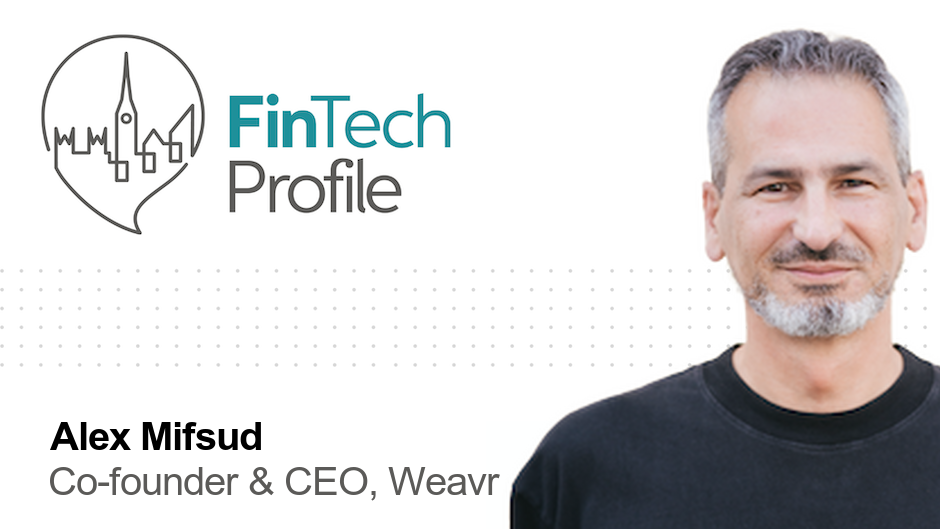
Today we're delighted to speak with Alex Mifsud, Co-founder and CEO of Weavr, a company providing embedded finance solutions for software businesses. With a background spanning virtual prepaid cards and multiple fintech ventures, Alex shares his vision for how AI agents and embedded finance will fundamentally reshape how we interact with financial services.
My questions are in bold - over to you Alex:
Who are you and what's your background?
I am driven by a need to understand why things are the way they are and how to tweak them to make them better. My background is rooted in engineering; I studied computer engineering at the University of Malta, focusing on bitslice processors, followed by a PhD at Edinburgh University centred on an algebra of interacting agents.
My entry into fintech began with creating safer ways to pay online, leading to the concept of virtual prepaid cards - a tweak on credit cards that removed the plastic, the account requirement, and the credit element. After founding Entropay and Ixaris, I founded Weavr to design safer ways to make money work with software. I'm excited by how this is evolving as we enter a world increasingly mediated by AI agents.
What is your job title and what are your general responsibilities?
I am the CEO at Weavr. While the early days were spent building the infrastructure to ensure safe, accessible financial integration, my focus today is heavily on go-to-market strategies. This includes sales and overseeing how we communicate the value of embedded finance to software businesses. I believe practice drives innovation, so I spend my time where "concept meets reality" to ensure our capabilities have the most impact. Cool stuff meets utility. Practice drives new insights that lead to further innovation.
Can you give us an overview of your business?
Weavr is built on the hypothesis that digital technology (apps, SaaS, or AI) cannot deliver comprehensive solutions unless it includes financial activity. However, traditional integration is difficult because financial institutions have strict security standards and often restrict third-party software from mediating transactions.
We believe the established Banking-as-a-Service (BaaS) model has fundamental flaws that have led many players into regulatory trouble. Weavr provides a safer, more compliant alternative. Using our proprietary scripting language, FinML (Finance Modelling Language), we assemble and operate financial solutions that meet regulatory standards whilst removing the compliance burden and risk from the software business.
Our core differentiator is that we work backwards from our customers' problems and using our proprietary scripting language FinML (Finance Modelling Language), we assemble and operate financial solutions that deliver what is needed. In this way, we ensure that each solution fully meets the required regulatory standards, we reduce complexity and time to market for the software business, and importantly, we remove for the software business the burden of compliance and the risks that come with it.
Tell us how you are funded?
We are venture-backed by investors who recognise that building regulated financial infrastructure is a long-term, capital-intensive commitment. Our funding has been dedicated to three pillars: securing a licence with a supportive regulator, building our unique technology stack, and developing high-quality banking and payment partnerships. Whilst this infrastructure is slow to monetise initially, it creates highly sticky, steadily growing revenue streams.
What's the origin story? Why did you start the company? To solve what problems?
Before Weavr, I founded Entropay, where we launched the first virtual cards for general use, and for the travel industry as a side activity, and later Ixaris, where we built embedded infrastructure specifically to support the travel business. These experiences showed me how powerful adding financial services to vertical applications (travel) could be, but also how incredibly difficult it was to build correctly. I saw a massive opportunity to simplify this for other digital businesses, which became the foundation for Weavr.
Who are your target customers? What's your revenue model?
Our customers are B2B SaaS platforms across sectors such as HR tech, expense management, accounting, travel, and procurement. They use Weavr to embed financial products that improve customer experience, increase retention, and unlock new revenue streams. Our revenue model combines platform fees with usage-based financial services, aligned to the value our customers generate.
If you had a magic wand, what one thing would you change in the banking and/or FinTech sector?
I'd remove the assumption that to deliver value from financial services means becoming a bank or even a fintech. It's totally accepted now that context provides one of the best opportunities to deliver superior value. Many software applications have a much more complete context - user data - than banks do with regards to customer objectives, and in addition, they are designed for action and interaction. Adding financial services to a well designed software application - whether that's related to running your business or living your life - has much more potential to deliver value to you. Which suggests a simple take-away for banks: finance should adapt to software workflows, not the other way around.
What is your message for the larger players in the Financial Services marketplace?
Embedded finance creates a huge new distribution opportunity for financial institutions. We're moving towards a world where businesses and consumers engage with financial services primarily through the everyday platforms they already use, rather than directly with institutions. Those who learn how to embed themselves into those platforms will be best positioned for the future.
Where do you get your Financial Services/FinTech industry news from?
I tend to favour thoughtful analysis over hype. The Economist is my weekly must-read (and not just for Finance), along with Simon Taylor's Fintech Brain food. Along with Simon, I follow a bunch of people whose opinions on fintech I respect even when we don't agree.
Can you list 3 people you rate from the FinTech and/or Financial Services sector that we should be following on LinkedIn, and why?
- Simon Taylor (Sardine / Fintech Brainfood): A primary voice on the infrastructure of fintech and how money moves.
- David Birch: Original and opinionated thinker and author, who is not afraid to take positions on controversial, still developing concepts (and I suspect a fellow avid reader of the Economist, given his tone of voice).
- Alex Johnson, Fintech Takes: a more narrowly focused commentator on fintech infrastructure, including Banking-as-a-Service, whose scoops and incisive analysis I really value.
What FinTech services (and/or apps) do you personally use?
Revolut and Wise are a couple of apps I use regularly - I've been a long term user, and they mostly get the job done, although the ever increasing number of features does not make them more attractive for me. Here's one other thing: for anything financial activity I do, investment, budgeting, etc, that requires analysis, I'm now using Claude and Gemini rather than dedicated fintech apps. Right now, actual trading or payment transactions are out of scope, but we're now at the cusp of fintechs starting to offer a reliable financial services execution layer - currently via MCP - that will work with these AI platforms. Currently these early MCP deployments are mostly focused on B2B but B2C can't be that far away.
What's the best new FinTech product or service you've seen recently?
Being in the UK, I want to call out Finary. I'm not a customer (yet) and I do not have any connection with the company, and this is not investment advice - but I think what they're doing is cool.
Finally, let's talk predictions. What trends do you think are going to define the next few years in the FinTech sector?
Several foundational shifts that began on the margins a few years ago, each with significant implications for fintech, are now approaching mainstream adoption. The confluence of agentic AI, agent-accessible financial services platforms, and stablecoin (and the DeFi capabilities built upon them) are fundamentally changing how financial services will be built, sold and consumed. Most financial regulators are not just aware and rightly cautious, but unlike in the early days of crypto and banking-as-a-service, they know they have to be safe enablers of these changes. My own area, embedded finance, and Weavr, is a precursor of the upcoming breed of safe financial execution layer providers. There's much to navigate, but oh so exciting to see this level of transformation.
We'd like to thank Alex for taking the time to share his insights with us. You can connect with Alex on LinkedIn or learn more about his company at weavr.io.