My Advice to Banks on AI: Ian Kerr of Insight Delivered
Ian Kerr shares practical advice for bank executives on avoiding AI pitfalls, prioritising real-time decisioning, and building data foundations that deliver ROI.
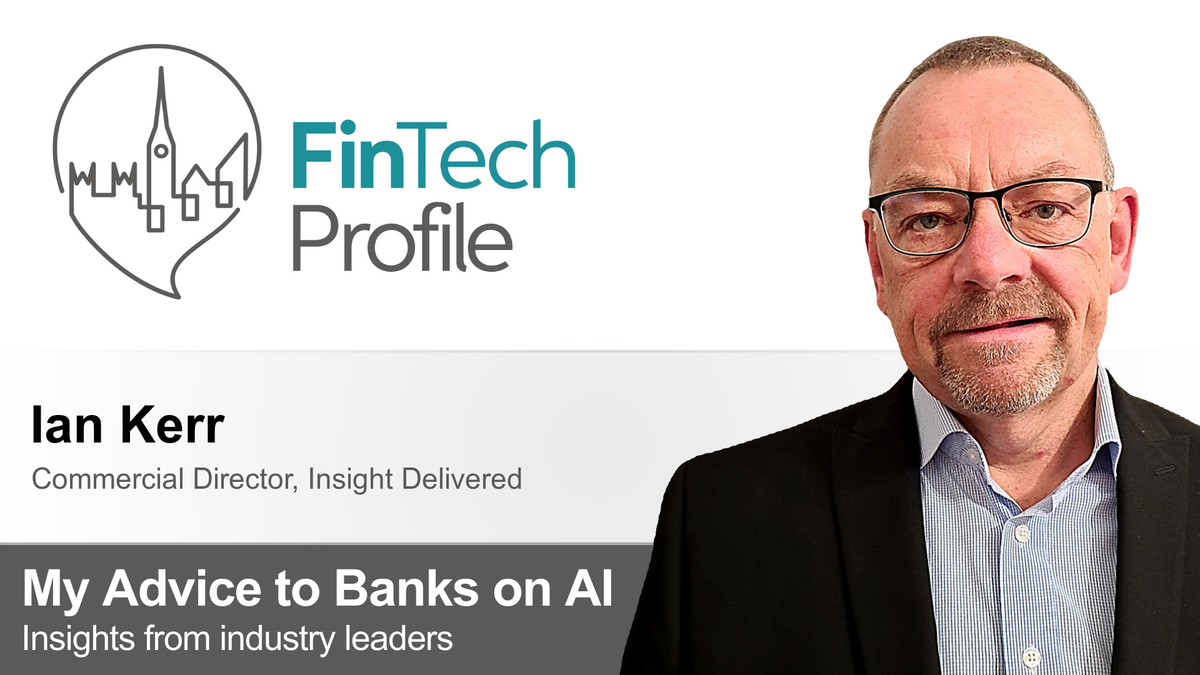
Continuing our AI Advice series, I spoke with Ian Kerr, Commercial Director at Insight Delivered, who brings over 35 years of financial technology experience spanning payments, core banking, and trade finance.
In this Q&A, Ian shares his practical advice for bank executives navigating the complexities of AI and data strategy—from avoiding the fear of missing out to prioritising capabilities that deliver immediate ROI.
Over to you Ian - my questions are in bold:
Can you give us an introduction to you and an overview of your organisation?
I have been working in financial technology for over 35 years, and my career has enabled me to do business across the world in payments, core banking, trade and supply chain finance among others. Insight Delivered has been around for over 10 years and has developed a well architected data analytics solution that efficiently manages data from multiple sources and applies AI to generate deep and relevant insights to guide business priorities. We can also work co-operatively with adjacent space systems and AI deployments.
If you were advising a bank CEO today, what would you say is the single biggest mistake they're making with data and AI?
There is a real risk of jumping on the AI bandwagon without giving due thought to how best value can be delivered while maintaining adherence to compliance and regulatory responsibilities. The fear of missing out can also lead to shortcuts being taken on data management and governance that are pivotal to AI success.
The biggest mistake I see is banks treating data and AI as technology projects rather than business transformation levers. Too many initiatives start with tools, models, or vendors, instead of beginning with the operational problems that matter most to customers and frontline teams. As a result, banks end up with impressive proofs of concept that never scale, or dashboards that look good but don't change behaviour.
The real issue isn't a lack of data or AI capability — it's the absence of a clear, cross-functional ownership model that ties data to outcomes. Until banks shift from "building AI" to "using AI to run the business better" they will continue to underdeliver on the potential sitting right in front of them.
What's one AI or data capability banks should prioritise in the next 12–18 months, and why?
Banks should prioritise real-time decisioning — the ability to use data and AI to make smarter, faster decisions at the moment a customer or risk event occurs. Whether it's credit, fraud, collections, onboarding, or personalised engagement, the institutions that can act in real time will outperform those that rely on batch processes and rigid rules.
This capability matters because customer expectations have shifted permanently. People now expect the same immediacy from their bank that they get from digital-first companies. Real-time decisioning is the foundation that enables hyper-personalisation, proactive risk management, and operational efficiency — all of which are essential for the next phase of banking competitiveness.
Where do you see banks overestimating AI, and where are they underestimating it?
The risk in over-estimating is seeing AI as a panacea for the bank's issues. The burden of legacy technology platforms and technical debt still exists and AI in fact highlights this further, there is still work to be done. At the same time, banks underestimate AI's ability to transform day-to-day operations. The biggest wins aren't always in glamorous use cases like generative chatbots or predictive models. They're in the mundane but high-impact areas: automating manual checks, reducing rework, improving data quality at source, and giving frontline teams better context. When banks focus on these "boring but powerful" applications, the ROI is immediate and undeniable.
What does "good" actually look like when AI and data are working well inside a bank?
The target vision would be to be able to bring data together from disparate internal and external sources to support enhanced customer service where agentic AI works co-operatively with human interaction to enhance the experience. Achieving this requires a well architected data management layer and AI guardrails to mitigate risks in a way that appears seamless as AI is embedded into workflows. Decisions are faster, customer journeys are smoother, and teams spend more time solving problems rather than gathering information. Leaders have a single, trusted view of performance, and frontline staff have the insights they need without having to ask for them.
In a truly mature environment, AI becomes part of the bank's operating rhythm. It flags risks before they escalate, identifies opportunities before competitors see them, and continuously learns from every interaction. When AI and data are working well, the bank feels more agile, more human, and more aligned around the customer.
What's the hardest AI or data decision bank executives are avoiding right now, and why?
Picking up on a point made above, a hard decision is to recognise that, typically, bank data is siloed and based on multiple structures and data models. Deciding to bite the bullet and bring this together into a normalised environment as a foundation for AI deployment and optimisation can seem daunting and expensive. With the right technology approach and plan it does not have to be, but the benefits of tackling these issues need to be understood and committed to.
Thank you Ian! You can connect with Ian on his LinkedIn Profile and find out more about the company at insightdelivered.com.