2026 FinTech Predictions: Insights from Vikas Krishan of Altimetrik
Vikas Krishan shares why AI governance frameworks, not just AI spending, will separate winners from losers in financial services in 2026.
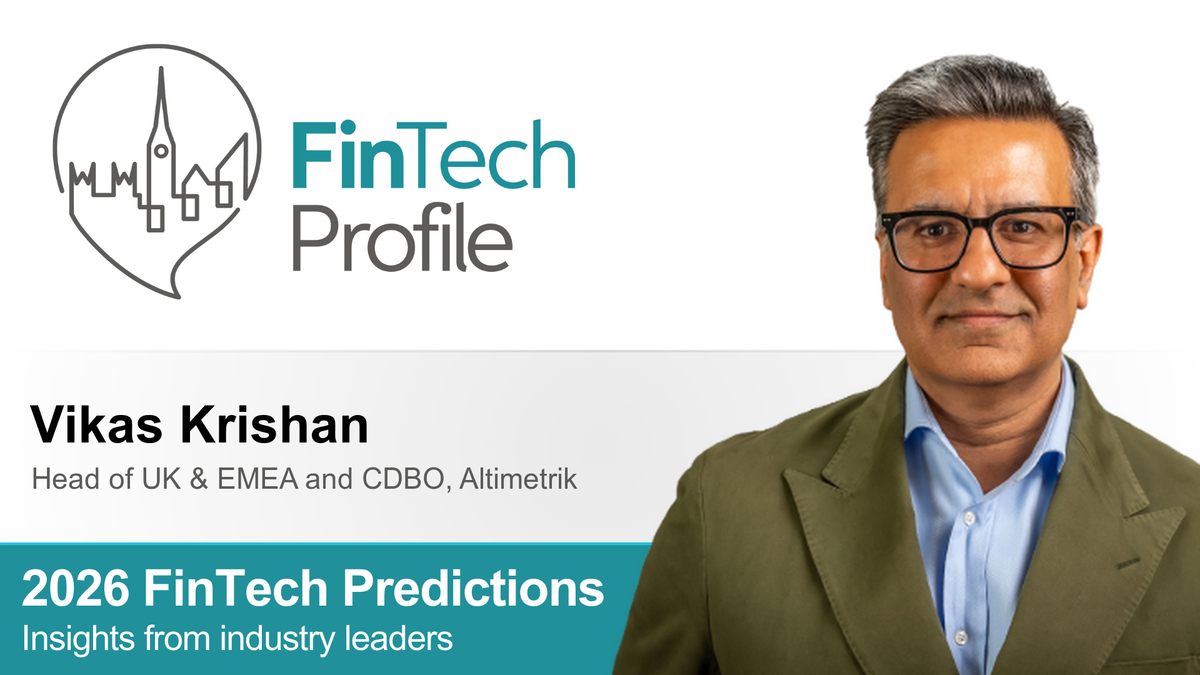
I spoke with Vikas, Head of UK & EMEA and Chief Digital Business Officer at Altimetrik, an AI-first digital engineering and services company working with fintechs and financial services organisations. With major banks now investing billions in AI infrastructure, Vikas shares his perspective on what will truly separate the industry leaders from the followers in 2026.
Over to you Vikas - my questions are in bold:
What's the biggest shift you expect across financial services in 2026?
What we're seeing in 2026 is firms looking at AI not as a cost-cutting exercise, but as a growth catalyst. Take Goldman Sachs – they're spending $6 billion on AI, and their CEO stated he wished he could spend $8 billion. The critical message was: 'I don't want people to think of this as spending $6 billion to get rid of people. We're spending $6 billion because we will grow the firm that much by leveraging AI.' This represents the fundamental shift in financial services – from AI as efficiency tool to AI as strategic growth driver.
To deliver this fundamental change, we see financial services firms really looking at the key frameworks that underpin and, in some cases, hinder the adoption of AI at scale. These include their data platforms, their business processes as well as the core AI frameworks and architectures that will be required for driving this exponential change.
Which emerging technology will have the most practical impact on banks and the FinTechs that support them?
Based on current trends, smaller specialised language models combined with multimodal AI interfaces will have the most practical impact on FinTechs in 2026. Unlike large, resource-intensive models, these targeted AI solutions offer the cost efficiency and computational practicality that financial institutions need while addressing the environmental concerns that are becoming increasingly important to the sector.
We also see our clients moving towards a "bring your own agent" mode of operation and beginning to develop champion networks to drive this modality.
What customer behaviours or expectations will most challenge banks and financial service providers?
The biggest challenge for banks and financial service providers will be the convergence of personal and professional AI expectations. As customers become accustomed to sophisticated multimodal AI in their personal lives – using vision, language, audio, and touch interfaces seamlessly – they'll expect the same fluid, intelligent interactions from their banking services. Banks that fail to match the AI experiences customers get from consumer tech will face significant competitive pressure.
What risks or blind spots do you think the industry is underestimating as we move into 2026?
For me, the biggest blind spot is governance and oversight. That's still the thing that lots of organisations haven't got right. We're seeing firms invest billions in AI infrastructure and models, but they're treating governance as something that can be added later and that's a fundamental mistake.
You've got to get all of this data structure right, the infrastructure, the data centres and the cloud. And then more importantly, the governance and the oversight. That's really what's going to separate those firms that use AI to grow their business versus those that are just using AI for simple cost cutting.
If you were advising a bank's leadership team today, what strategic priority should they focus on to stay competitive in 2026 and beyond?
My advice would be simple but critical: build your governance and oversight framework first, then align AI to your strategic business outcomes, not the other way around. This approach clarifies which processes should be agentified and where AI can deliver the greatest impact.
I see too many FinTech businesses rushing to deploy AI because their competitors are, without asking the fundamental question: what are we actually trying to achieve?
Here's what I'd tell them to focus on:
First, define your mission clearly. What do you need to achieve? Then translate that into strategy, break it down into work streams, and only then identify where AI can support execution. When you begin to think about it that way – top down – and you begin to think about those building blocks to execute the strategy, that's when AI can fundamentally drive greater productivity, efficiency, and insight.
Second, get your governance right before you scale. The governance and oversight – that for me is still the thing that lots of organisations haven't got right. You've got to get the data structure right, the infrastructure, the data centres and the cloud. And then more importantly, the governance. Build an AI registry within your organisation that has ethical compliance and legal guardrails from a regulatory perspective. Make compliance and ethics a design feature, not something you bolt on afterward.
The banks that will win in 2026 and beyond won't be those with the most sophisticated models or the biggest AI budgets. They'll be the ones that get foundational things right: strategy alignment, governance frameworks and using AI to drive growth rather than just efficiency.
Thank you Vikas! You can connect with Vikas on his LinkedIn Profile and find out more about the company at www.altimetrik.com.