2026 FinTech Predictions: Insights from Vazgen Gevorkyan
Industrialist and financier Vazgen Gevorkyan predicts the collapse of the fintech-banking divide and warns that institutions planning in annual cycles are already behind.
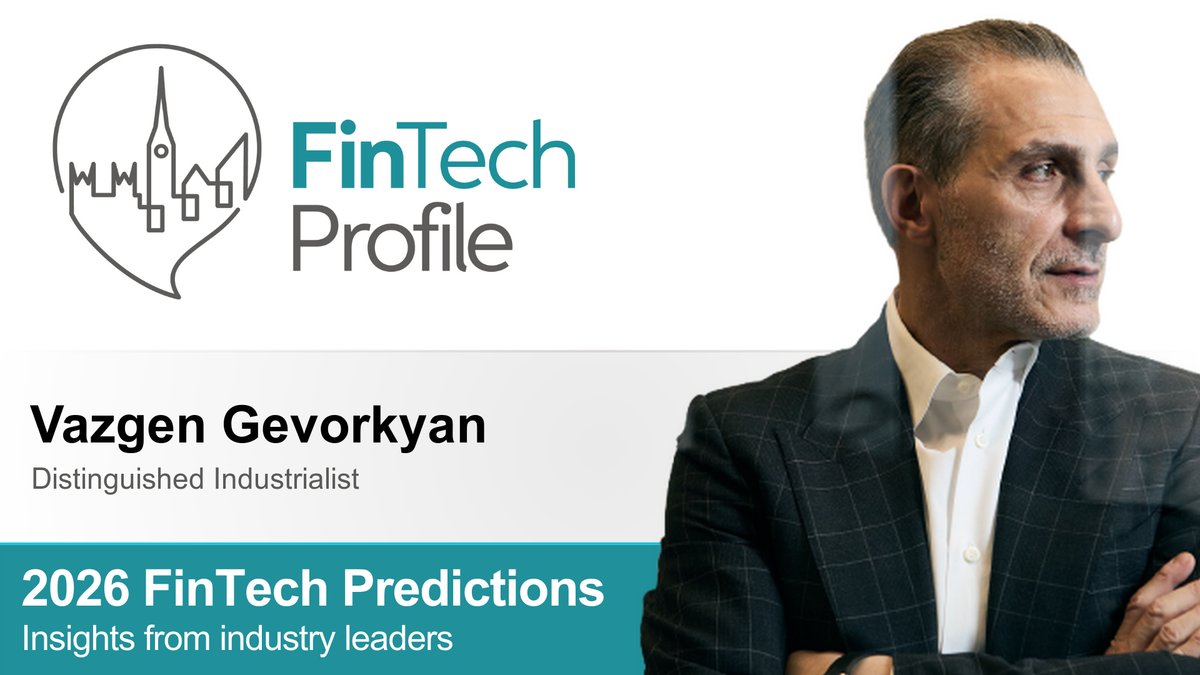
We spoke with Vazgen Gevorkyan, a distinguished industrialist, financier, and technologist renowned for his unique perspective at the intersection of real-world asset development, financial innovation, and technological transformation. He shares his predictions on what financial services leaders should expect in 2026 and beyond.
Over to you Vazgen, my questions are in bold:
What's the biggest shift you expect across financial services in 2026?
The divide between fintech and traditional banking is collapsing, but not in the way most people expect. Fintech companies without banking licences will hit their ceiling, while banks without fintech capabilities will continue losing ground. The future belongs to whoever solves this integration first. We're already seeing capital move rapidly to jurisdictions that accommodate this hybrid model.
The old formula of taking deposits at 3%, lending at 6%, and managing compliance with 150 people versus fintech's one-person processes isn't sustainable. The winners will be institutions that can operate at both regulatory credibility and technological speed, not those stuck doing only one.
Which emerging technology will have the most practical impact on banks and the FinTechs that support them?
Digital currencies are moving from regulatory experiments to practical implementation, and this will force both regulators and banks to adapt faster than they're comfortable with. The cryptocurrency conversation has shifted from scepticism to cautious acceptance amongst institutions. What's practical about this moment isn't the technology itself but the regulatory arbitrage it creates.
Fintech platforms will continue expanding globally precisely because they face fewer regulatory constraints than traditional banks, and this window won't last forever. The technology that matters most is whatever allows you to work at the intersection of traditional finance, fintech innovation, and emerging digital currencies. That's where the clear path forward exists.
What customer behaviours or expectations will most challenge banks and financial service providers?
Customers are developing fintech expectations with traditional banking trust requirements, and most institutions aren't prepared for this combination. People want the speed and simplicity of a one-person fintech operation, but they also want the regulatory protection and capital backing of established institutions. The Revolut-style model demonstrates what this looks like in practice.
Banks that continue operating with 150-person processes for what should be automated will lose customers who won't tolerate the inefficiency. At the same time, fintechs without proper licensing will hit credibility limits with customers who've learnt to value regulatory oversight. The challenge isn't choosing between speed and safety anymore. Customers expect both and immediately.
What risks or blind spots do you think the industry is underestimating as we move into 2026?
The speed of change itself is the blind spot. Tools that took months to develop previously now appear in weeks, and falling behind isn't gradual anymore; it's immediate. Most institutions are still planning in annual cycles when the actual dynamics change quarterly.
The industry is also underestimating how quickly capital mobility will punish markets with heavy regulatory environments. We're seeing global trade shifts with emerging currencies beginning to challenge dollar dominance, whilst established financial centres push large capital away through taxation structures that penalise success. The financial system serves as a guarantor of sovereignty. If you can't provide conditions for holding large capital, you risk losing relevance entirely, and this is happening faster than most regulators realise.
If you were advising a bank's leadership team today, what strategic priority should they focus on to stay competitive in 2026 and beyond?
Accept that you need to operate across multiple jurisdictions and stop assuming your current market position is permanent. Capital mobility is accelerating, and the traditional assumption that money stays put based on historical relationships is outdated. Your strategic priority should be building the capability to operate with fintech efficiency whilst maintaining regulatory credibility. This means fundamentally restructuring how you handle compliance, not just adding digital features to old processes.
The leaders who will succeed are those who combine experience from multiple disciplines, remain flexible enough to change strategy rapidly, and can deliver consistent results regardless of geography. Being ready to take your operations to new markets isn't about expansion anymore. It's about survival and making your services accessible to more people globally.
Thank you to Vazgen Gevorkyan for sharing these insights on the future of financial services.