
2026 FinTech Predictions: Insights from Tommaso Jacopo Ulissi of Nexi Group
Nexi Group's Head of Strategy shares bold predictions for 2026: software-based payments, agentic AI commerce, and Europe's push for payment sovereignty.
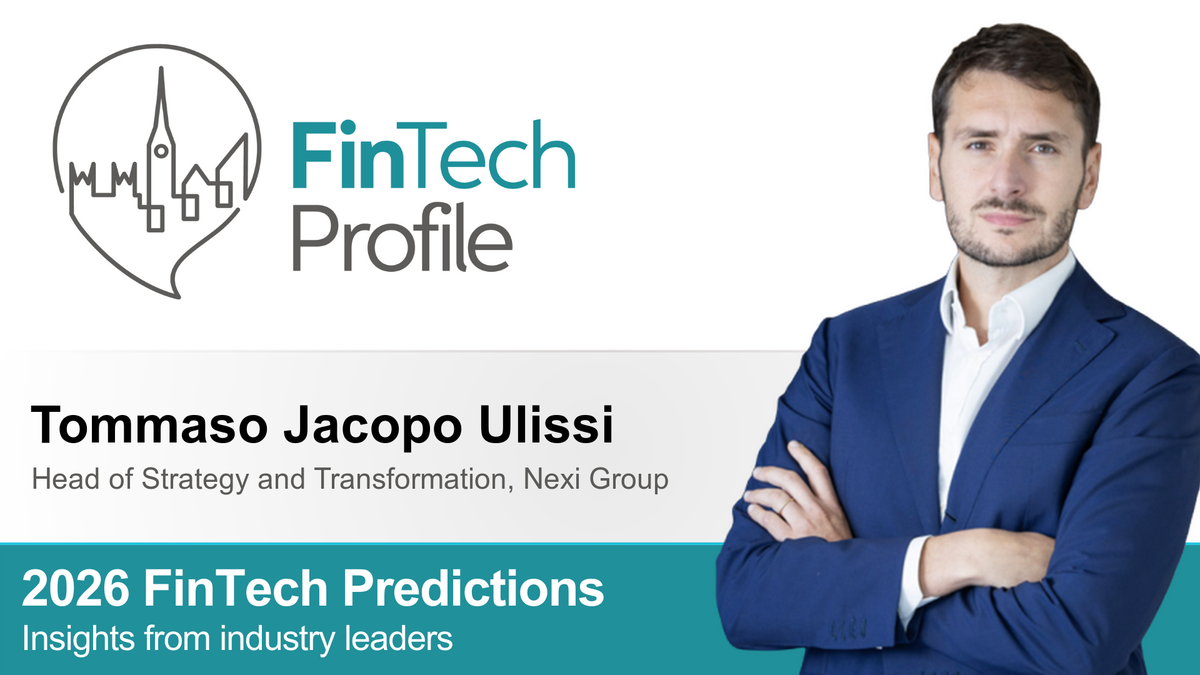
I spoke with Tommaso, Head of Strategy and Transformation at Nexi Group, Europe's leading payment company. With his strategic vantage point overseeing transformation across one of the continent's most influential payment providers, Tommaso shares his perspective on the forces reshaping financial services in 2026.
Over to you Tommaso - my questions are in bold:
What's the biggest shift you expect across financial services in 2026?
Software-based payments will accelerate access to a range of payment options this year, meaning anyone who needs to deliver a payment function will be able to do so. It sounds simple but it will be truly transformative.
The shift will be driven by ISV partnerships and mobile payment acceptance. Independent Software Vendors (ISVs) are increasingly forming partnerships with payment providers. By integrating payments directly into ecosystems, designed around merchant use cases – rather than payments – digital onboarding becomes much easier, helping more merchants start and grow their businesses.
A merchant using Shopify or Adobe Commerce, for example, will be able to access 'plug and play' payments, integrated within wider business software, enabling consistency across channels, with no discrepancies in pricing, discounts, or loyalty rewards.
Mobile payment acceptance is also set for dramatic growth in 2026. Some pioneering merchants have already begun using personal smartphones as trusted payment acceptance terminals. The benefits are clear: a device they already own can reliably and securely accept contactless and QR code-based payments.
For consumers, this "SoftPOS" solution offers highly-secured payment acceptance, enabling them to make purchases at their own convenience, whether that's in their house, in the market or in a shop – anywhere! For merchants, it's ultra-accessible, easy to set up and operate, and relatively low cost compared to traditional POS hardware.
In 2026, this will lead to new shopping behaviours: it will untether staff from the checkout desk, enabling them to be redeployed throughout the store to engage with shoppers, offer personalised shopping experiences and create additional upsell opportunities. Say goodbye to long lines waiting for a free cashier at the checkout desk.
Which emerging technology will have the most practical impact on banks and the FinTechs that support them?
2026 will mark the beginning of a new trend that could completely transform how consumers shop online. Banks and fintechs must recognise the transformative potential of this emerging technology to ensure they have the foundational infrastructure to support adoption – I'm talking, of course, about agentic (AI) commerce.
Agentic commerce can offer every consumer access to their own personal, highly intelligent shopping assistant. Once it reaches its potential, it means vastly reduced time and effort browsing countless websites trying to find the right product, in the right size, for the right price, with the right delivery option. The AI agent will do the heavy lifting, providing options for consumers to approve, based on specific instructions. All the consumer will have to do is select the preferred option and authorise the AI agent to buy it on their behalf, using secure, tokenised card details.
We saw the first bold steps toward this in 2025: OpenAI launched "Buy it in ChatGPT", enabling users in the U.S. to make single-item purchases with select retailers. The Generative AI giant also announced that PayPal wallets will be integrated within its Instant Checkout offer from 2026.
Every week there is more movement in this space and at Nexi, we're pleased to be involved in initiatives such as Google's Agent Payments Protocol (AP2), which enables users to initiate and transact secure, agent-led payments through mandates and verifiable credentials.
As such technology evolves over 2026, users will have an opportunity to gain trust and familiarity with agentic commerce. We can ultimately expect the traditional checkout – where the user browses a site and adds items to a basket – to be turned on its head. Banks and the fintechs that support them must start, among other things, defining internal policies for agent identity, building programmable money controls and rethinking fraud models for agent behaviour.
What customer behaviours or expectations will most challenge banks and financial service providers?
Today's consumer is empowered. They have high expectations for shopping experiences and expect to be feel recognised and valued. This evolution has made it increasingly tricky for merchants to effectively differentiate. For example, where loyalty programs were once seen as a value-add, today it's expected as the norm.
Banks and financial service providers must find new ways to enable their merchant clients to differentiate, lest they risk losing business to more forward-thinking competitors. In 2026, a fresh fusion of personalised payments and verticalized software will mark a major leap forward.
By tailoring the checkout experience to the environment in which it is being used, instead of adopting a one-size-fits all approach, merchants can differentiate themselves more distinctly than ever before, offering an experience that adds mutual value to the business and its customers.
One industry primed for a personalisation transformation in 2026 is hospitality. This sector is highly specialised, with a dynamic ecosystem of enabling platforms. Guests expect everything to be fast, easy, and personal; while merchants seek a unified combination of innovative hardware and agile software to deliver a streamlined "one-stop-shop" experience and exceptional customer service.
Integrated payments across the entire hospitality stack can tie guest profiles to a personalised customer offer, supported by seamless payments at every touchpoint. So, in 2026, whether you are checking in, booking a spa treatment, or ordering dinner at the restaurant, you can pay without friction and without interruption, creating the ultimate guest experience.
Delving deeper into the restaurants example, these are quite a unique use case for payments: you pay after consuming the goods, the bill may be split, and you may choose to tip the staff with something extra. Technology must be able to support such varied needs and behaviours, not just on behalf of paying customers, but for business operations too.
SmartPOS is one example of a unified commerce solution that transforms the checkout from a simple payment-acceptance station into a comprehensive business operations hub. Businesses using the technology in 2026 can enhance their operational efficiency, enabling staff to manage fragmented business operations services, such as bookings or inventory management, all from a single terminal.
The same SmartPOS terminal, keeping with our restaurant example, can not only offer payment options tailored to the customer's preference, but it can also: recognise returning customers and automatically apply loyalty benefits; recall previous orders to make tailored menu suggestions; and enable staff to personalise interactions at the table, based on a guest's dining history.
In 2026, banks and financial service providers must ensure they demonstrate understanding of the challenge facing their merchant customers. Those that do so by offering a fusion of personalised payments and verticalized software will ensure they keep their existing merchant client roster happy, while attracting new business throughout the year.
What risks or blind spots do you think the industry is underestimating as we move into 2026?
The pressures on Europe's payment rails are mounting. Payments today have become part of critical national infrastructure: if a payment system goes down, even for just a few hours, it can cause significant economic and societal harm.
Rising geopolitical tensions mean such operational resilience is constantly being tested, with growing threats to undersea cables and targeted attacks on core infrastructure. While the industry is increasingly waking up to the importance of payment resilience, many still underestimate the catastrophic impacts a payment outage can have on day-to-day life.
In 2026, expect the industry to place renewed focus on robust, fallback payment solutions, such as offline payments from terminals that can encrypt and locally store transaction data at the Point of Sale (POS), syncing when connectivity resumes. Finland, Sweden, Norway, Denmark, and Estonia are already developing offline payment capabilities based on deferred authorisation. Expect more countries to follow suit in the next twelve months.
If you were advising a bank's leadership team today, what strategic priority should they focus on to stay competitive in 2026 and beyond?
The current European payment ecosystem is too reliant on non-European schemes, networks, technology providers and standards-setters. This reality limits the ability of European banks to shape the future of payment innovation, to capture value from payments-adjacent services and to compete with global platforms on equal terms.
At Nexi, we're closely involved in several initiatives that will help deliver sovereign, resilient European payment options. One such initiative is the digital Euro, which aims to ensure a similar level of privacy and resilience to the physical Euro. This requires an ability to pay offline, with no third-party involvement. The European Central Bank has selected a cooperation between Giesecke+Devrient, Nexi and Capgemini to deliver this capability, to make offline digital euro payments available to users and merchants. This work will take place through 2026 as part of the critical groundwork needed to develop a trusted digital currency for Europe.
This move, along with several others, will help reduce Europe's over-reliance on international card schemes and the high fees that can result from dependent relationships. Supporting this is Wero, built by the European Payments Initiative (EPI) with involvement from Nexi and other payment stakeholders to deliver instant payments. In 2026, Wero will be developed further to cover online checkout and person-to-person (P2P) payments, similar to services like Swish and Venmo.
Our goal is to ensure robust, resilient, interoperable payment options continue to deliver value for financial organisation, merchants and consumers alike, across the continent.
Thank you Tommaso! You can connect with Tommaso on their LinkedIn Profile and find out more about the company at www.nexigroup.com.