2026 FinTech Predictions: Insights from Rav Hayer of Thoughtworks
Rav Hayer predicts 2026 will be the year of 'invisible banking' as financial services embed seamlessly into everyday digital experiences through AI, tokenisation, and programmable money.
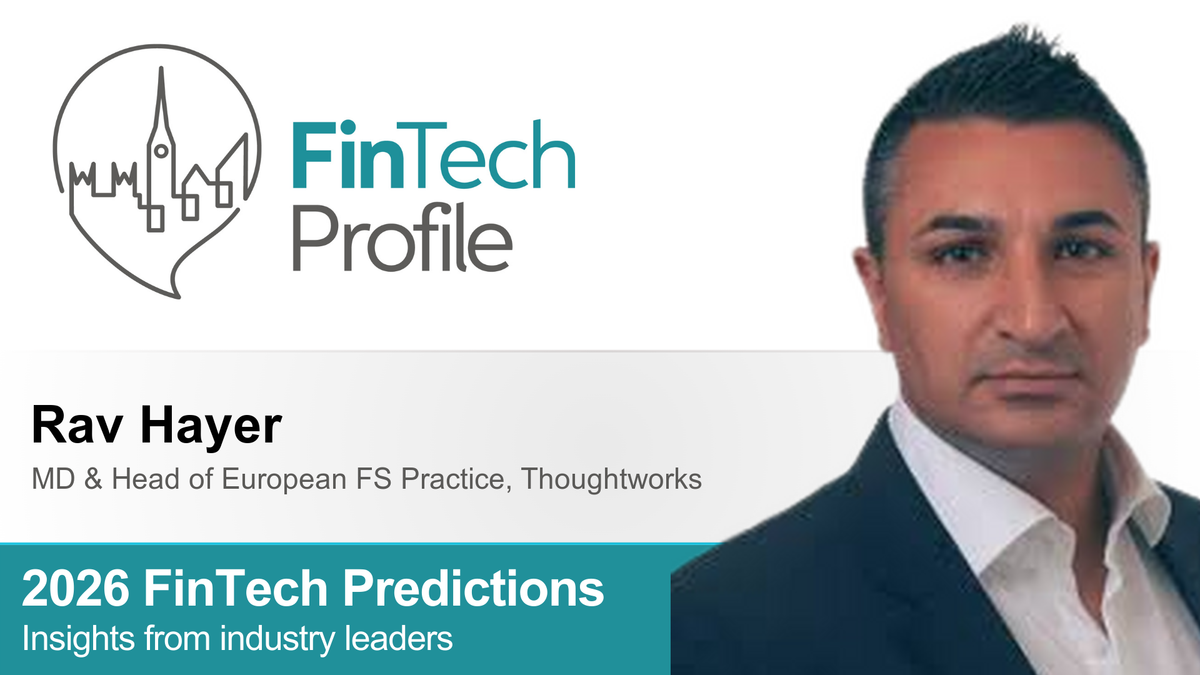
I spoke with Rav Hayer, Managing Director for UK & Ireland and Head of European Financial Services Practice at Thoughtworks, about the seismic shifts set to transform financial services in 2026. From invisible banking to tokenised assets and the accessibility imperative, Rav shares his perspective on the opportunities and blind spots facing the industry.
Over to you Rav - my questions are in bold:
What's the biggest shift you expect across financial services in 2026?
I predict 2026 will be the year of "invisible banking." Banks won't just provide accounts, cards, or loans, they'll be seamlessly integrated into the apps, platforms, and digital experiences we use every day, like the recent payments integration on ChatGPT. You may search for holiday inspiration on the ChatGPT app next year, and instantly be able to pay for your flights and hotel then and there. All in one place. This is a big leap: moving from reactive service providers to proactive, almost invisible engines that anticipate and respond to needs before customers even realise them. For example, a bank can now detect that you've just bought a house and proactively offer a home insurance deal.
Across EMEA, we're already seeing early signs of this shift: NatWest consolidating millions of customer records for AI readiness, Deutsche Bank building tokenized asset platforms, and HSBC embedding AI into transaction monitoring. These initiatives are moving beyond experiments and are now redefining the meaning of a modern, relevant bank.
Which emerging technology will have the most practical impact on banks and the FinTechs that support them?
I'm really excited by tokenised assets and programmable money, everything from stablecoins to securities. Standard Chartered predicts that the stablecoin sector will grow from $280bn to $2tn by 2028. It's easy to see why: they offer lower costs and greater transparency for cross-border transactions, a notoriously slow and complicated task. We've seen Klarna launch their payment stablecoin to dramatically reduce costs for both merchants and consumers, by cutting our parties such as the Swift network.
Stablecoin closes some of the gaps in how value moves, settles, and is managed across the financial system. With tokenisation, transactions can settle instantly instead of taking days. Costs drop, liquidity becomes far more flexible, and new opportunities emerge to create and move value in ways that simply haven't been possible before.
The impact isn't just operational efficiency. Tokenised assets are forcing banks to rethink everything: compliance frameworks, infrastructure design, and even how they collaborate with other institutions. Traditional rails and slow legacy systems weren't built to handle this level of real-time, programmable money. For example, initiatives like Deutsche Bank's tokenised asset platform or HSBC experimenting with tokenised deposits are early signs that banks are starting to treat digital assets not as an experiment, but as a core part of their strategy. At Thoughtworks, we are monitoring stablecoin's rapid ascent closely as more of our global customers look to digital tokens as an offering.
What customer behaviours or expectations will most challenge banks and financial service providers?
In my experience consulting with clients, it's clear that customer expectations are evolving faster than most banks realise, but not everyone experiences banking in the same way. Vulnerable customers, including people with disabilities, those with limited digital literacy, or older adults, often face barriers that many institutions don't see. Convenience alone isn't enough for them; they need integration, personalisation, and trust, delivered in ways that are truly accessible. Customers are also increasingly aware of how their data is used, and they rightfully expect transparency, accountability, and ethical handling of AI-driven insights. Accessibility is not just a "nice-to-have", it is commercially imperative. With aging populations and growing focus on digital inclusions banks that fail to design for diverse abilities risk alienating millions of potential customers while also falling short of regulatory expectations. It's not just about frustrating users, brands also risk losing relevance and market share.
What risks or blind spots do you think the industry is underestimating as we move into 2026?
Firstly, legacy systems are still a massive blocker. I've mentioned exciting new updates with AI, tokenisation, and embedded finance, but if core systems can't scale, integrate, or handle new types of transactions, all that investment will underperform.
Second, regulation is complex and evolving. Frameworks like the EU AI Act, DORA, MiCA, and various national open finance regulations are forcing banks to operate in an environment where compliance can feel like a field of landmines. Ignoring these frameworks or moving too fast without proper oversight could result in financial, reputational, and operational fallout.
And lastly, another glaring blindspot I see is assuming customers will trust banks just because they are faster or more automated. Trust has to be earned through responsible design, clear communication, and consistent reliability.
If you were advising a bank's leadership team today, what strategic priority should they focus on to stay competitive in 2026 and beyond?
I frequently tell senior leaders to stop thinking about incremental change. Start from scratch and reimagine how you would create systems if you were day one of a scrappy startup, rather than a huge global organisation.
Where are areas for quick wins? Get your data prime time ready- all too often when tech teams go into an organisation's back office, it's a jumbled, siloed mess. Without this clean data, companies can't properly use agentic AI, which relies on the system performing multi-step reasoning and actions on its own.
AI is bound to make mistakes. It can never be perfect. So, I also tell clients to focus on hyper-personalisation, but to do it responsibly. Deliver recommendations and offers tailored to individual customer needs, but do it transparently, ethically, and inclusively. Accessibility should be treated as a design principle, never an afterthought.
And finally, it sounds like a buzzword, but invest in culture. Employees need to be comfortable with AI, digital platforms, and rapidly changing technology. Innovation is as much about people as it is about tech.
Thank you Rav!
You can connect with Rav on his LinkedIn Profile and find out more about the company at https://www.thoughtworks.com.