2026 FinTech Predictions: Insights from Nick Rugg of Markel International
Nick Rugg, Head of Fintech Insurance at Markel International, shares his predictions on AI deployment, operational resilience, and the real-time transformation reshaping financial services.
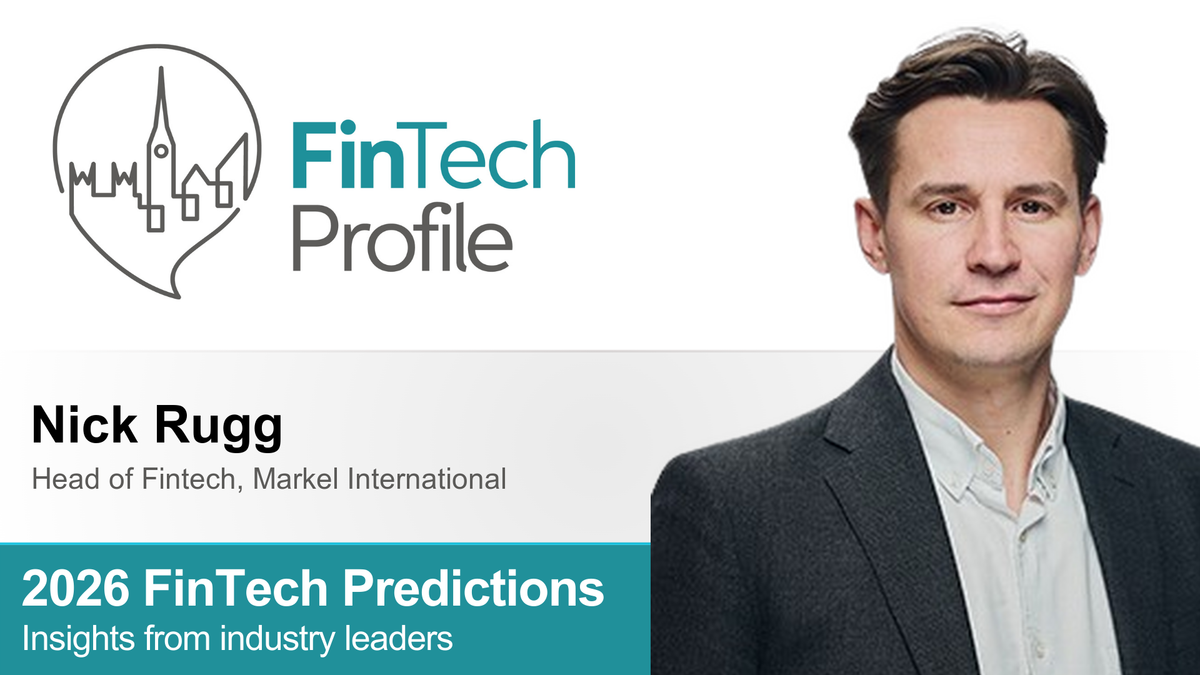
I spoke with Nick Rugg, Head of Fintech and Investment Management Insurance at Markel International, a leading global specialty insurer with a people-first approach.
Nick brings deep expertise in the insurance challenges facing banks and FinTechs as they navigate rapid technological change and evolving regulatory demands. In this interview, he shares his perspective on what 2026 holds for the financial services sector.
Over to you Nick - my questions are in bold:
What's the biggest shift you expect across financial services in 2026?
In 2026, we'll see an evolution in how financial services are built and delivered to customers.
The most consequential shift will be the normalisation of real-time, data-rich transaction and servicing flows across the value chain, driven by instant payments, open finance and AI, combined with far stricter expectations on governance and resilience.
Instant payments powered by open banking will accelerate, and we'll see the evolution of this in open finance, widening the scope of financial services to mortgages, savings, pensions, insurance, investments and credit products.
As the financial services industry continues to be more innovative and technologically advanced, regulators will play a key part in how far the shift goes. The FCA has a clear focus on operational resilience following the introduction of the operational resilience regime in 2025, requiring companies to prove they can prevent, withstand, respond to and recover from operational disruptions. Other key focus areas will be Consumer Duty, anti-money laundering (AML) and fraud controls as well as e-money safeguarding.
Which emerging technology will have the most practical impact on banks and the FinTechs that support them?
In the near-term, AI embedded into core banking and payment workflows will have a big impact on banks and supporting fintechs. Some of the key areas where AI can support banks in their operational risk are in strengthening fraud detection through real-time monitoring and anomaly detection, improving credit risk modelling with more accurate, dynamic data, enhancing operational resilience via automation and predictive maintenance, reducing human error-driven losses in back-office processes, and improving regulatory compliance with automated surveillance and reporting.
Fintech companies have leveraged AI to improve APP fraud detection following the APP Mandatory Reimbursement scheme that was implemented in October 2024, and early indications are that it has been effective.
What customer behaviours or expectations will most challenge banks and financial service providers?
Speed and execution will be a top priority for customers in 2026. These requirements will continue to challenge legacy operating models because customers now expect instant payments, instant credit decisions and extremely efficient dispute resolutions.
There's also an increasing expectation that financial services should be embedded in commerce and non-financial platforms. This will put pressure on banks and financial service providers to ensure they're adequately monitoring their partners, ensuring they don't face adverse consequences, such as potential regulatory and compliance breaches, risk to data privacy and security, as well as reputational damage.
What risks or blind spots do you think the industry is underestimating as we move into 2026?
There's the potential for companies to be over-reliant on service providers with exposure to a single point of failure, which can have significant impacts on businesses if their vendor encounters a breach or a complete system shutdown.
Rapid AI deployment without robust testing standards, data lineage and access governance creates exposures such as bias in lending, fraud model drift, phantom correlations in AML and inadvertent PII exfiltration. There's also exposure to complaints around mis-selling or unfair outcomes linked to models.
As the UK framework for fiat-backed stablecoins and tokenised assets crystallises, firms risk underestimating operational and segregation requirements, wallet/key management exposures and cross-border treatment. Firms will also have to be mindful of the impact of Consumer Duty standards regarding fair value, good customer outcomes and risk warnings.
The challenge for the industry will be striking a balance between innovation, operational resilience and regulatory compliance.
If you were advising a bank's leadership team today, what strategic priority should they focus on to stay competitive in 2026 and beyond?
Transforming the full operating model towards being AI enabled with robust governance.
Banks will need to prioritise their real-time data capabilities so that they are ready to reap the benefits from a fraud prevention, credit, customer service and compliance perspective.
This will have to be done with robust governance, ensuring they stay away from the pitfalls of rapid deployment without adequate testing, as well as ensuring that they are compliant with the evolving regulatory environment towards AI.
Thank you Nick! You can connect with Nick on his LinkedIn Profile and find out more about the company at markel.com.