2026 FinTech Predictions: Insights from Marko Sjoblom of Fiinu PLC
Fiinu's CEO predicts plugin credit will create a new banking market in 2026, while warning of financial exclusion risks from reduced mainstream credit access.
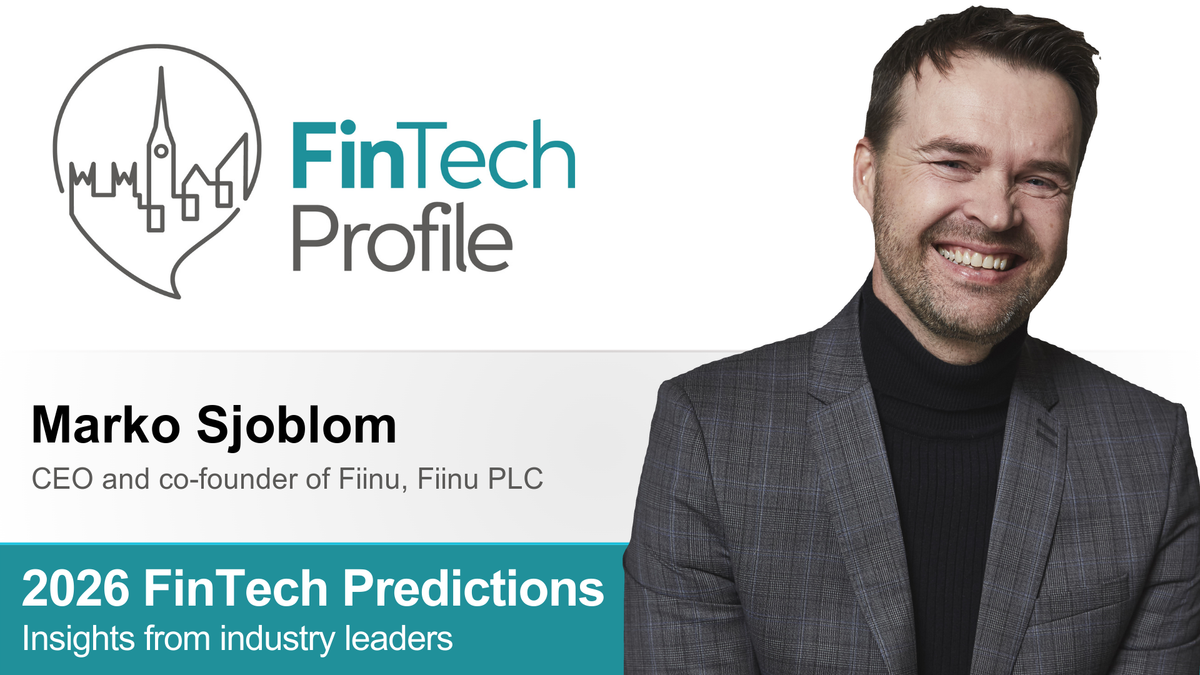
I spoke with Marko Sjoblom, CEO and co-founder of Fiinu PLC, a UK-based fintech company providing digital lending and financial services.
Marko shares his perspective on the emergence of unbundled banking products, the risks of financial exclusion, and why partnership models will define competitive advantage in the years ahead.
Over to you Marko - my questions are in bold:
What's the biggest shift you expect across financial services in 2026?
The most significant shift will be a creation of a new market in banking, plugin credit. For decades, banks have operated on the premise that bundled products create customer stickiness, for instance, in retail banking with a current account including an overdraft, a debit card, maybe some rewards. But this model is increasingly at odds with consumer behaviour and regulatory direction. In 2026, I expect we'll see the infrastructure shift to a point where consumers can genuinely start to pick and choose financial products from different providers without the friction of switching banks. Open Banking has laid the groundwork, but we're now moving into an era of disruptive innovation where the plumbing works well enough for unbundled credit products to create a new market foothold. The real test is described as the innovator's dilemma, i.e. whether incumbents adapt their business models or whether they initially give up the low end of the market as predicted by the related theory.
Which emerging technology will have the most practical impact on banks and the FinTechs that support them?
AI-driven underwriting and affordability assessment will be the technology with the most tangible impact, though perhaps not in the flashy way some expect. Traditional Probability of Default models are optimised for secured lending and often produce binary outcomes for unsecured credit. But when you leverage Open Banking data and apply sophisticated AI to analyse cash flow patterns, spending behaviours, and financial resilience indicators, you can make far more nuanced, accurate decisions with dynamic pricing. We've seen firsthand how this approach can responsibly extend credit to populations that traditional models systematically exclude, the result is improved financial inclusion. The banks and fintechs that master this will gain a significant competitive advantage, not just in approvals but in managing risk more intelligently across the entire customer lifecycle. Also, tokenisation will increase in popularity, but it won't have the most practical impact on the market until later.
What customer behaviours or expectations will most challenge banks and financial service providers?
The expectation that financial products should work seamlessly with their existing infrastructure, not require them to rebuild their financial lives around a new provider. We've conducted extensive research showing that consumers are extraordinarily reluctant to switch their primary banking relationships, even when offered objectively better products. Yet they're simultaneously frustrated by their bank's limitations—particularly around access to credit. This creates a paradox for traditional banks: customers want innovation and better products, but they won't switch to get them. The challenge for providers in 2026 will be meeting customers where they are, quite literally. Products that require switching, new apps, new account numbers, new direct debits—these will increasingly struggle against solutions that integrate into customers' existing financial ecosystems. Providers that can't adapt to this "stay where you are" expectation will find themselves competing on increasingly thin margins for an ever-shrinking pool of customers willing to switch.
What risks or blind spots do you think the industry is underestimating as we move into 2026?
The industry is dramatically underestimating the consequences of Open Banking and reduced credit access for the mass market. When overdraft regulations changed in 2020, approximately 16.5 million people lost overnight access to unarranged overdrafts—creating a £10 billion gap in the UK market alone. Rather than being celebrated as a consumer protection victory, we should recognise this as an unintended consequence that's pushing vulnerable consumers towards far worse alternatives. The blind spot is assuming that people who lose access to mainstream credit simply tighten their belts. Andrew Bailey refers to this as the waterbed effect, in reality, people turn to less mainstream alternatives such as Point of Sale Credit like Buy Now Pay Later schemes. When these firms will be obliged to report their data to credit bureaus, the masses will hear from media how their credit scores have worsened. Data also suggests that two-thirds of first-time mortgage borrowers' applications are rejected if their credit file includes a mark of such non-bank products.
The long-term damage to credit scores, financial resilience, and ultimately financial exclusion is severe. We're storing up significant social and economic problems that will manifest over the next few years.
If you were advising a bank's leadership team today, what strategic priority should they focus on to stay competitive in 2026 and beyond?
Focus relentlessly on partnership models and infrastructure plays rather than trying to own the entire customer relationship. The future of banking isn't about being everything to everyone—it's about being excellent at what you're good at and partnering for the rest. For incumbent banks, this means recognising that your banking licence, regulatory expertise, and balance sheet are valuable assets that can power innovative products created by others. Rather than seeing fintechs as existential threats, view them as innovation partners who can help you serve customers you're currently failing to reach.
The white-label model we're deploying with Conister Bank is a template for this future. They bring regulatory permissions and customer relationships, we bring technology and underwriting innovation, and together we can address market needs that neither could serve independently. Banks that embrace this collaborative approach will find themselves participating in a much larger ecosystem of financial services.
Thank you Marko! You can connect with Marko on his LinkedIn Profile and find out more about the company at fiinuplc.com.