2026 FinTech Predictions: Insights from Karli Kalpala of Digital Workforce
AI reasoning models will transform financial services from productivity tools to infrastructure, enabling autonomous operations in credit, compliance, and KYC.
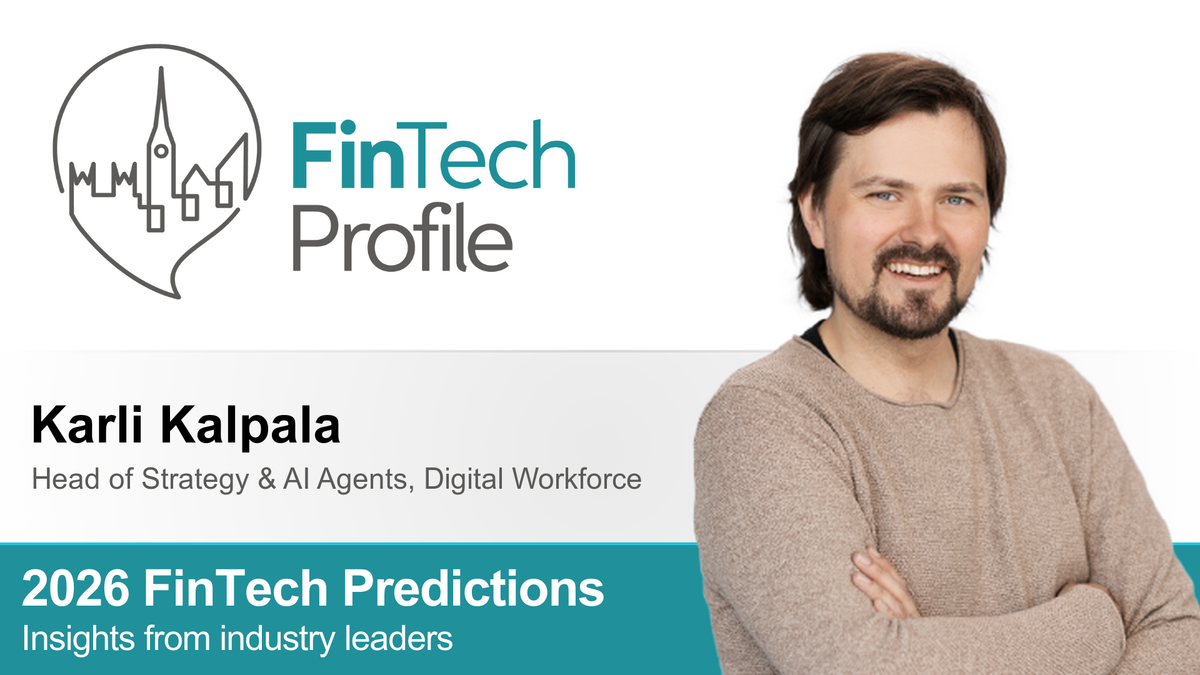
I spoke with Karli Kalpala, Head of Strategy & AI Agent Business at Digital Workforce, to explore what 2026 holds for financial services transformation. With expertise in AI implementation across banking and insurance operations, Karli shares their perspective on how reasoning models and organizational maturity will separate leaders from laggards in the year ahead.
Over to you Karli - the questions are in bold:
What's the biggest shift you expect across financial services in 2026?
The defining shift in 2026 will be the industry's transition from treating AI as a departmental productivity tool to recognising it as infrastructure that transforms entire value chains. We're moving beyond the pilot mentality that has characterised much of the past few years. Financial institutions that have been cautiously experimenting are now at a critical decision point on whether to commit to systemic redesign or risk falling permanently behind competitors rebuilding operations from the ground up.
Success in this shift will also be determined less by the technology deployed and more by organisational maturity in change management. The institutions pulling ahead are those whose leadership understands that transformation requires process redesign and people development, not just software deployment. We'll see a clear divergence between organisations stuck in endless AI solution piloting and those achieving measurable ROI through full operational integration. Leaders will have fundamentally reimagined how work flows through their organisations, particularly in areas like underwriting, claims assessment, and risk modelling in insurance, where scaling human reasoning has historically been the bottleneck.
Which emerging technology will have the most practical impact on banks and the FinTechs that support them?
AI reasoning models will have the most consequential technological impact on financial services because they enable the automation of work previously impossible to automate. Until now, information networks in financial services have always required humans as connection points. Someone had to read a document, apply judgment, and create another document. Reasoning models change this dynamic entirely by translating the document to the other one without human involvement.
This capability also unlocks automation potential in asset management, accounting, and compliance, sectors where the core reason humans existed in the process was that their reasoning was needed to interpret unstructured information and make decisions. The shift is comparable to how internet transformed banking infrastructure in the early days, except the impact will be far more profound because it reaches into cognitive work that has resisted automation for decades.
For banks and FinTechs, this means document-heavy processes such as credit assessments, KYC verification, regulatory reporting, and fraud investigation can operate autonomously and scale across large population sizes from intake through resolution. The technology enables agentic AI systems that don't just assist human workers but redesign operational flows entirely. We're already seeing early movers in payments and lending achieve cycle time reductions in processes that previously required multiple human touchpoints. The institutions that will extract real value are those approaching this not as a software upgrade but as an opportunity to rethink who or what does the work in their organisation enabling an entirely new operating model, building new exception handling processes and governance frameworks suited to autonomous decision making at scale.
What customer behaviours or expectations will most challenge banks and financial service providers?
Customers' growing experience with AI in consumer technology is resetting their expectations for financial services interactions. Customers increasingly expect instant, contextual responses and seamless resolution of complex requests, shaped by AI-powered experiences with companies like Spotify, Netflix, and modern e-commerce platforms. Financial institutions face pressure to deploy customer-facing AI solutions that can match this experience whilst navigating far more stringent regulatory requirements and risk considerations than consumer tech companies. The gap between what customers now consider standard service and what traditional financial services can deliver through legacy systems and processes is widening fast. Younger demographics, particularly, are showing willingness to switch providers based purely on digital experience quality, which makes this a customer retention issue.
As banks also deploy more autonomous AI systems, customers will demand both the efficiency these systems provide, and the assurance about how decisions affecting their financial lives are made. These institutions must build confidence in AI-driven processes and be transparent about when and how human oversight occurs. Research suggests customers are comfortable with AI handling routine transactions but want human escalation paths for complex or high-stakes matters. Banks that do not address this trust dimension will find customers uncomfortable with the AI systems meant to serve them better.
What risks or blind spots do you think the industry is underestimating as we move into 2026?
The industry's most dangerous blind spot is the assumption that AI transformation is primarily a technology challenge when the real work is organisational change. Too many financial services leaders are still approaching AI as a software deployment exercise, which is reflected in how they measure success by the number of models in production and not operational redesign. AI tools and agents only create value when organisations rethink how work is performed, how decisions are made, and how people operate differently. Financial providers that overlook this only build technical debt quickly and limit the ROI that the technology can deliver.
There's also insufficient focus on AI literacy and workforce readiness across entire organisations, not just technical teams. As financial services move toward agentic AI systems operating autonomously, organisations need to prepare people to collaborate effectively with these agents and maintain proper oversight. The risk isn't that AI systems will fail technically but that organisations will deploy them without building the governance frameworks and cross-functional capabilities needed to operate confidently. We're also seeing early signs of a talent war for people who can bridge AI capabilities with domain expertise in banking, insurance, and capital markets, and most institutions are underprepared for this competition.
If you were advising a bank's leadership team today, what strategic priority should they focus on to stay competitive in 2026 and beyond?
The priority should be committing to full operational transformation with AI. This means banks should reimagine roles across credit operations, fraud detection, customer onboarding, and regulatory compliance.
For example, in credit decision making, AI agents can now process financial documents, assess risk indicators, and flag applications that fit clear approval criteria. This amplifies the value of skilled credit analysts who can focus on portfolio strategy and make judgment calls on edge cases and applications that fall outside standard parameters. Similarly, in fraud operations, AI can monitor transactions and detect patterns at scale, freeing fraud specialists to investigate sophisticated schemes and work with law enforcement.
Bank leaders should also not measure AI success by headcount reduction but by data-driven improvements in decision quality, processing speed, customer satisfaction, and risk management outcomes.
About the Author
Karli Kalpala is the Head of Strategy & AI Agent Business at Digital Workforce Services Plc and specializes in driving innovation with AI agents and transforming businesses with enterprise automation. An advocate for the future of autonomous systems, Kalpala joined Digital Workforce in 2016 and has held multiple leadership roles, including head of business service and design and head of implementation services. His leadership centers on transforming enterprise workflows through strategic AI initiatives and automation, aiming to elevate operational efficiency across sectors.
Thank you Karli.
Connect with Karli on LinkedIn and read more about Digital Workforce at digitalworkforce.com