2026 FinTech Predictions: Insights from John Stevens of Kyriba
John Stevens, SVP Global Head of Capital Markets at Kyriba, shares predictions on real-time treasury operations, AI integration, and the liquidity challenges banks will face in 2026.
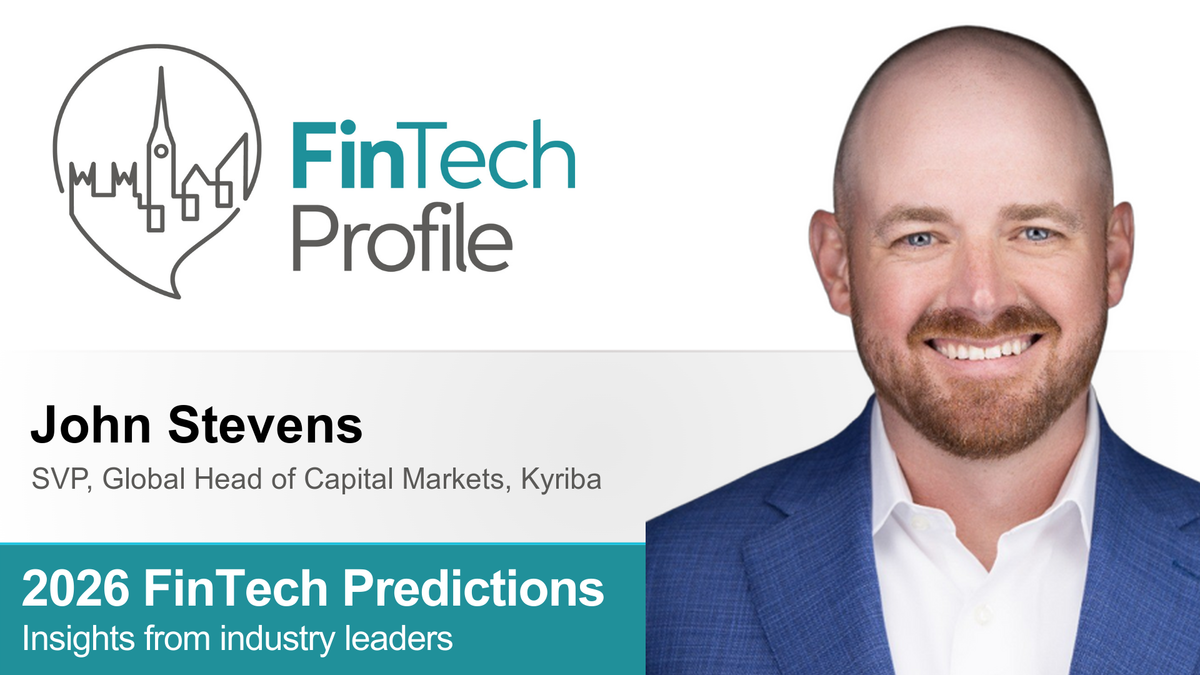
We spoke with John Stevens, SVP and Global Head of Capital Markets, Financial Institutions & Working Capital at Kyriba, a globally recognised leader in treasury management and liquidity performance.
Over to you John - my questions are in bold:
What's the biggest shift you expect across financial services in 2026?
The biggest shift will be the move from digital banking as a channel strategy to real-time insights and connected financial operations at the core. In 2026, customers won't judge financial institutions by the number of digital features they offer, but by whether they can deliver a unified, always-on view of liquidity, risk, and performance across products and geographies. That requires breaking down data siloes across custodians, platforms, and internal systems so insights and actions happen in the moment not after slow manual consolidation. The firms that win will treat connectivity (APIs, clean data, and workflow automation) as foundational infrastructure, enabling continuous optimisation and faster decision-making across payments, treasury, markets, and wealth.
Which emerging technology will have the most practical impact on banks and the FinTechs that support them?
Integrated AI solutions which enhance predictive analytics and scenario planning, will have the most practical impact on workflows. The real value won't come from AI as a standalone "tool," but from AI that is fed by connected data and tied directly to execution: forecasting liquidity, identifying risk, optimising funding, and recommending actions with clear rationale and oversight. In parallel, tokenisation and stablecoin rails will move from pilots to pragmatic use cases. We will see stablecoins reduce friction in settlement and cross-border value transfer. This is particularly important when speed, transparency, and operating costs matter.
What customer behaviours or expectations will most challenge banks and financial service providers?
The most challenging shift is that customers increasingly expect consumer-grade immediacy with institutional-grade sophistication. They want a single, integrated experience with real-time visibility across holdings and liquidity, predictive insights rather than static reporting, and seamless execution across markets and currencies. Patience for fragmented portals, delayed data, and manual "we'll get back to you" processes is disappearing, especially as fintechs normalise 24/7 access and automated workflows. Additionally, expectations for personalisation are rising with customers requesting advice and service tailored to their situation without higher fees or slower turnaround. Meeting those expectations forces banks to modernise underlying data and operating models, not just redesign interfaces.
What risks or blind spots do you think the industry is underestimating as we move into 2026?
A major blind spot is overestimating how far you can go with AI and automation without fixing data fragmentation and governance first. Many organisations will deploy "intelligent" layers on top of inconsistent, delayed, or incomplete data, thereby creating confident outputs that are hard to trust, audit, or operationalise.
Another underappreciated risk is the growing interdependence of market volatility, geopolitical fragmentation, and liquidity constraints, which can turn localised disruptions into rapid, cross-border funding and FX challenges.
Finally, as tokenisation and faster payment rails expand, firms may underestimate the operational and control implications—new points of failure, new fraud vectors, and the need for real-time monitoring and exception handling to match real-time movement of value.
If you were advising a bank's leadership team today, what strategic priority should they focus on to stay competitive in 2026 and beyond?
I'd prioritise building a connected, real-time liquidity and decisioning platform focused on aligning data, APIs, automation, and analytics to achieve visibility, speed and resilience for customers. That means investing in unified data foundations, integrating across custodians and internal silos, and embedding predictive analytics into frontline workflows so relationship teams and operations can act immediately with confidence.
Done well, this becomes a compounding advantage: faster insight, better service at scale, stronger risk management, and the ability to adopt new rails (real-time payments, tokenised assets, stablecoins) without repeated reinvention. In 2026, competitiveness will increasingly be defined by how quickly you can turn information into action—securely and consistently.
Thank you John! You can connect with John on his LinkedIn Profile and find out more about the company at www.kyriba.com.