2026 FinTech Predictions: Insights from Herman Man of Bluevine
Herman Man, Chief Product Officer at Bluevine, predicts the rise of agentic AI in finance and explains how autonomous agents will transform banking workflows in 2026.
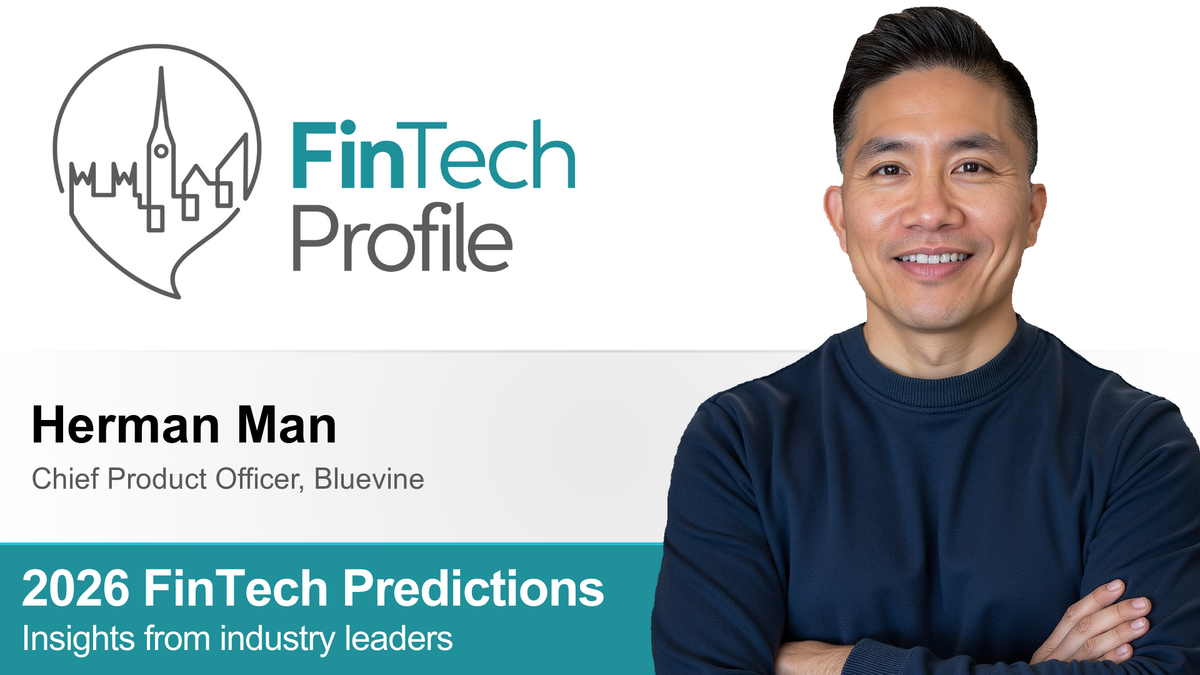
We spoke with Herman Man, Chief Product Officer at Bluevine, the largest digital banking platform in the US. As a leader shaping product strategy for small business banking, Herman shares his perspective on how artificial intelligence will fundamentally reshape financial services operations and customer expectations in the year ahead.
Over to you Herman - my questions are in bold:
What's the biggest shift you expect across financial services in 2026?
With the emergence of AI, we think 2026 will yield the year of agentic finance. Autonomous AI agents will begin executing complex workflows—from underwriting and fraud monitoring to offering personalised financial products—under human-in-the-loop governance. SMB customers will use their own personal AI agents to find the best products and offerings, which means financial service providers–now more than ever–must build products that demonstrate outsized value.
Which emerging technology will have the most practical impact on banks and the FinTechs that support them?
Agentic AI will have a very practical impact for banks and fintechs. There will be auditable AI agents embedded directly into core banking workflows. This will mean more consistent, durable, and efficient operations. For example, if suspicious transactions are detected, an agent may gather Know Your Customer (KYC) data, cross reference against adverse media and draft a Suspicious Activity Report (SAR). AI agents may also be deployed to do credit and underwriting, leading to better operating costs and improved time to resolution across the entire customer base. The overall customer experience will be improved.
What customer behaviours or expectations will most challenge banks and financial service providers?
I think customers will demand more from their financial service providers. They will expect "smarter" services that are personalised and context aware. For example, a customer who banks with a financial institution that offers accounting, may expect auto-reconciliation between the banking and accounting ledgers, autonomous transaction categorisation, and the flagging of tax-deductible expenses.
What risks or blind spots do you think the industry is underestimating as we move into 2026?
The industry definitely isn't underestimating it, but fraud and bad actors are continuing to grow so prevalent, so bold, and so sophisticated in their schemes. Bad actors will continue finding new ways to exploit AI. Anything less than hyper-vigilance won't be enough.
If you were advising a bank's leadership team today, what strategic priority should they focus on to stay competitive in 2026 and beyond?
My biggest advice is that, when it comes to winning customer loyalty in the small business sector, offer products and services that truly solve their needs. This means spending time and deeply knowing your customers, and understanding their pain points. Leverage AI to free you up so you can do the things it can't.
Thank you Herman! You can connect with Herman on his LinkedIn Profile and find out more about the company at www.bluevine.com.