2026 FinTech Predictions: Insights from George Brady of HTEC
George Brady of HTEC predicts financial institutions will shift from scattered AI pilots to focused programmes, while multi-agent systems transform back-office operations in 2026.
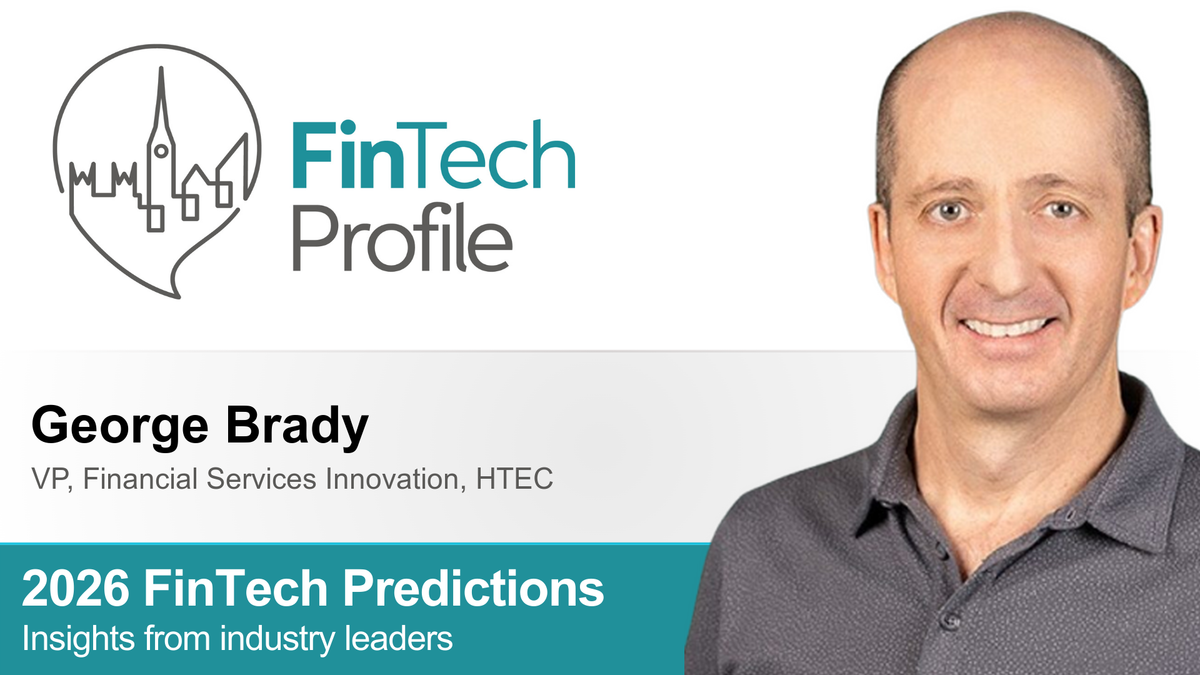
We spoke with George Brady, VP of Financial Services Innovation at HTEC, a global AI-first provider of strategic software, hardware-embedded design, and engineering services. With his deep expertise in financial services transformation, George shares his perspective on the pivotal shifts coming to the industry in 2026.
Over to you George - my questions are in bold:
What's the biggest shift you expect across financial services in 2026?
The biggest shift will be financial institutions hitting a pragmatic reset. The "let a thousand flowers bloom" era of scattered AI pilots is done. We're moving to highly focused, top-down programmes with measurable, compliant outcomes. The consumerisation of AI created expectations that outstripped reality, and now there are monetary implications to running endless experiments with no clear outcome. The larger institutions have already created AI studios and centres of excellence to concentrate expertise - that's the model that wins.
Which emerging technology will have the most practical impact on banks and the FinTechs that support them?
Multi-agent systems will have the most practical impact. Agentic AI in back and middle office operations will be the focus in 2026. We're talking about automating genuinely complex, high-value workflows using multi-agent systems. Loan origination is the perfect example - gathering income statements, financial documentation, all those manual processes that slow approvals to a nauseating crawl. The challenge isn't the technology. It's changing the workflow for people accustomed to working in a certain way for many years.
What customer behaviours or expectations will most challenge banks and financial service providers?
The biggest challenge will be customers using ChatGPT for tax preparation. There's genuine risk around people plugging their information into ChatGPT for tax returns in 2026. They think it is great technology that will just work. It won't. LLMs are fundamentally biased towards telling people what they think they want to hear - and that's a total disaster for tax compliance. We could see a massive spike in audit failures, and government bodies will struggle to process returns generated by AI that wasn't designed for this purpose.
What risks or blind spots do you think the industry is underestimating as we move into 2026?
Data quality is the elephant everyone's trying to eat one bite at a time. Companies with data silos and poor-quality data are building AI on quicksand. You might achieve 90-95% accuracy, but for something like tax preparation, that's catastrophic. This isn't something you flip a switch and solve - it's a seven-to-ten-year journey for companies that have neglected it. In 2026, you'll see who's been doing the foundational work and who's still pretending.
If you were advising a bank's leadership team today, what strategic priority should they focus on to stay competitive in 2026 and beyond?
Legacy modernisation separates the serious players from the rest. Any institution more than five years old has legacy, and the real question is what they're doing about it. Creating modular, API-first cores is essential for running AI at scale, but it's a decade-long journey. The serious players started this work five years ago. The rest are realising the hard way that they can't build AI on antiquated architecture. A change that should take two weeks might take six months because they're dealing with a monolithic system where one wrong move breaks everything.
Thank you George!
Find out more about George on LinkedIn and read more about their company at http://htec.com.