2026 FinTech Predictions: Insights from Bruce Martin of Tax Systems
Bruce Martin, CEO of Tax Systems, shares his predictions for 2026, covering AI agents, tax transformation, and the strategic priorities banks need to stay competitive.
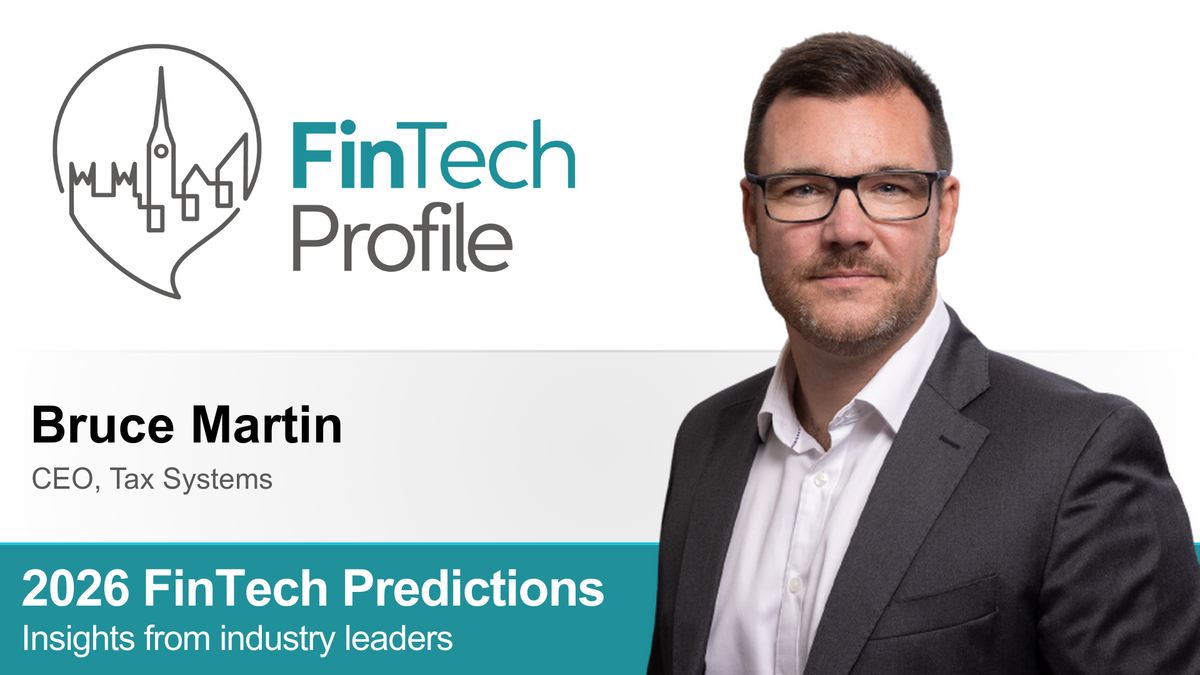
I spoke with Bruce Martin, CEO of Tax Systems, to get his perspective on what 2026 holds for financial services.
Bruce shares his views on how tax functions are evolving from compliance-driven operations to strategic capabilities, the practical impact of agentic AI, and the blind spots organisations are underestimating as regulatory complexity increases.
Over to you Bruce - my questions are in bold:
What's the biggest shift you expect across financial services in 2026?
The biggest shift across financial services in 2026 will be the move from fragmented, compliance-driven tax functions to integrated, strategic approaches. After years of managing tax through disconnected systems, spreadsheets, and point solutions, organisations are increasingly focused on creating a centralised source of data. This is becoming critical as new regulations, such as Pillar Two, increase the interdependence between tax data and processes, driving both complexity and a greater need for efficiency. Data now needs to be consistent, connected, and accessible across the business – not reconciled after the fact. In an environment of growing regulatory scrutiny, tax can no longer operate in isolation.
But this shift is not just a regulatory exercise. By consolidating tax data, businesses will gain visibility, control, and confidence, creating a foundation for faster decision-making, stronger insights, and more proactive engagement across the organisation. As a result, over the next 12 months, businesses will prioritise operating models that embed tax into the broader finance and risk ecosystem, aligning more closely with the office of the CFO and giving tax a seat at the table for strategic decision-making and value-add activities.
Those that succeed in 2026 will be the organisations that reposition tax from a back-office compliance function to a strategic capability – one that is consulted by finance, trusted by leadership, and able to support resilience, transparency, and sustainable growth, this year and beyond.
Which emerging technology will have the most practical impact on banks and the FinTechs that support them?
Agentic AI marks the next step of evolution for AI, and will be one of the most significant technological shifts we see in 2026. Unlike generative models that simply respond to prompts, agentic AI can operate autonomously and make decisions in pursuit of defined objectives, posing a great opportunity for the fintech sector to drive even more efficiencies with AI.
As organisations move from AI experimentation to a more disciplined, outcomes-driven approach, Agentic AI will come out on top by demonstrating tangible, measurable results and long-term value. With trust building over time, we will see its rollout progress in stages throughout the year. First of all, AI agents will be deployed in low-risk use cases, such as data entry or document screening. This will add immediate value and free up significant amounts of time, without disrupting existing controls. As confidence grows, agents will start to take on more tasks and responsibilities, such as reviewing outcomes, flagging anomalies, highlighting risks and preparing summaries, all whilst keeping the "human in the loop". This isn't about replacing people, it's about augmenting them.
As adoption matures, and debate around an "AI bubble" continues, businesses will gain greater clarity on where AI truly delivers impact and where it becomes an expensive distraction. In a highly regulated environment, this will mean prioritising scalable, well-governed deployments that enhance transparency and avoid unnecessary complexity. Those that adopt a targeted, outcomes-led strategy will be best placed to build resilience and sustain competitive advantage in 2026.
What customer behaviours or expectations will most challenge banks and financial service providers?
The answer is, again, AI. As customer expectations become increasingly polarised, some will actively embrace AI-driven services, pursuing efficiencies and innovation, whilst others will remain cautious, prioritising transparency, human oversight, and reassurance around how data is used and decisions are made.
This divergence will place pressure on software providers to strike a difficult balance of innovating quickly without alienating customers who value trust and human judgment. The challenge will not be whether to adopt AI (those that don't will get quickly left behind!), but how to deploy it responsibly and visibly in ways that enhance customer outcomes rather than obscure them.
As the initial hype around AI begins to settle, organisations will be forced to cut through the noise and focus on where the technology genuinely adds value. Those that take a disciplined approach – using AI to remove friction, simplify processes, and empower employees rather than replace them – will be best placed to meet rising customer expectations while maintaining confidence and credibility in a rapidly evolving landscape.
What risks or blind spots do you think the industry is underestimating as we move into 2026?
One of the biggest blind spots is the extent to which tax functions are underestimating the importance of robust, connected data foundations. As tax processes become more interdependent, data points are being pulled from multiple systems, often maintained for different purposes. Without a centralised view of data, inconsistencies and inaccuracies can quickly arise as the same information is maintained across several datasets. What might once have been manageable within a single workflow now cascades across the tax function, increasing risk, slowing delivery and eroding confidence in outputs.
Pillar Two compliance is a clear example of the risks of this approach. The framework introduces another layer of complexity on top of an already complex tax environment, requiring multinational groups to interpret evolving rules, manage granular data, and apply highly technical calculations across jurisdictions. As a result, reporting relies on data points that are shared across tax reporting processes such as provisioning and country-by-country. Where this data remains siloed or manually managed, particularly through spreadsheets, it is near impossible to ensure accurate reporting.
As we move into 2026, these weaknesses are becoming more pronounced. For those in scope of Pillar Two, compressed implementation timelines means many organisations will be forced to prioritise short-term solutions to meet the June filing deadline. While this may enable compliance in the near term, it leaves the underlying data foundations unchanged and creates longer-term fragility within the tax operating model.
By centralising data, and connecting interdependent tax processes, tax teams will have the visibility and control needed to reduce risk, improve decision-making, and position tax as a strategic function within the office of the CFO.
If you were advising a bank's leadership team today, what strategic priority should they focus on to stay competitive in 2026 and beyond?
UK businesses will remain under intense cost pressure in 2026, as prices continue to rise. Organisations can't absorb those pressures indefinitely, so reevaluating current policies and processes will be a crucial strategic priority as we enter a new year. After years of layering on top of existing structures, many organisations are left with a knot of complexity that's expensive to run and difficult to change. The most effective leaders will take a more disciplined look at which processes are essential and which can be removed altogether.
Once that focus is established, the next step is to review the tools that your team is using. You wouldn't send a construction worker to dig a hole with a teaspoon; yet we routinely do the equivalent in back-office functions by asking people to deliver more with outdated systems, duplicated datasets and manual workarounds. 2026 should be the year that organisations make the investments needed to drive efficiencies. AI and centralised datasets will be pivotal in this regard, enabling organisations to do more with less as budgets tighten.
Yet, it isn't all about speed. Those who truly gain a competitive advantage will be the ones who embrace modern technology, particularly AI, as an opportunity to do something new, not just improve current processes. This will enable them to unlock new insights, new ways of working, and fresh avenues for innovation that will keep them one step ahead in 2026.
Thank you Bruce! You can connect with Bruce on his LinkedIn Profile and find out more about the company at taxsystems.com.