2026 FinTech Predictions: Insights from Boris Bialek of MongoDB
MongoDB's Field CTO Boris Bialek shares his predictions for 2026, highlighting the critical need for unified data foundations and the rise of agentic AI in financial services.
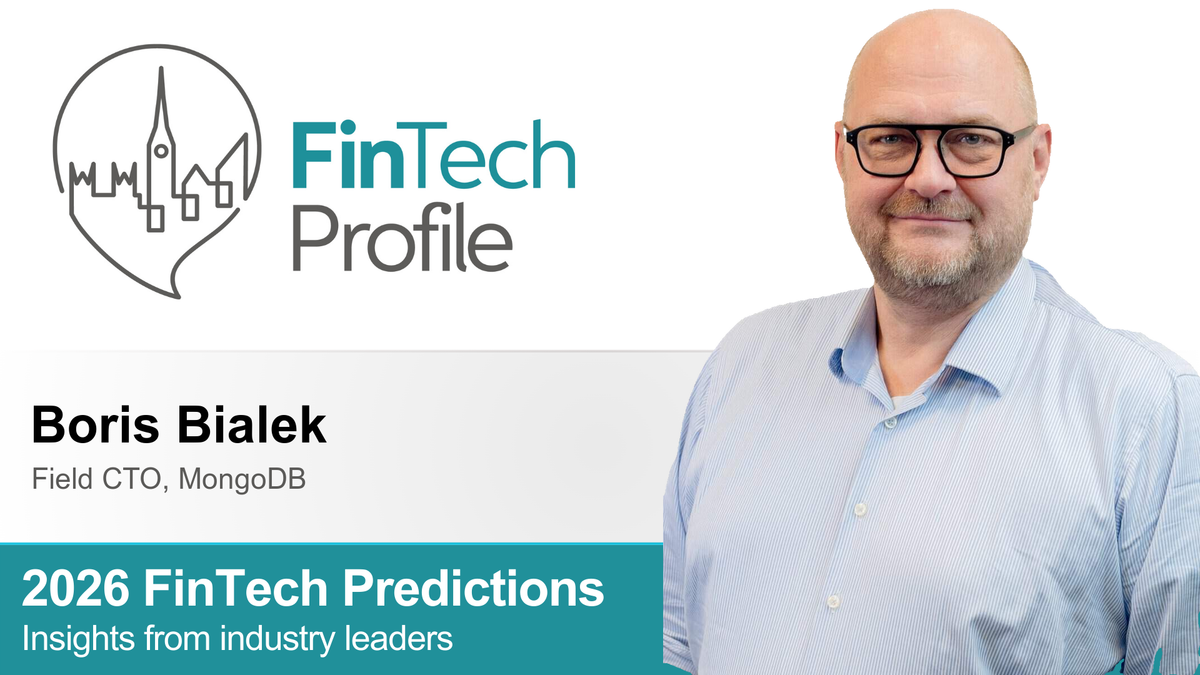
We spoke with Boris, Field CTO at MongoDB, the leading database platform for modern applications. With his expertise in data infrastructure and digital transformation, Boris offers compelling insights into how financial institutions must evolve to meet the challenges and opportunities of 2026.
Over to you Boris - my questions are in bold:
What's the biggest shift you expect across financial services in 2026?
In 2026, I suspect organisations will start to realise digital transformation is not just a project that you can tick off a list. We'll see organisations breaking down the old silos between product, risk, compliance and tech. Data that used to be stuck in different systems will be connected, giving a single live view of customers and operations. 2025 was slightly marred by system shutdowns and cyber-attacks, so it's more vital than ever that financial service organisations get their own houses in order.
It's not just about being more efficient and cutting costs; it's about making smarter decisions. This could be spotting a new customer, managing risk or making your product feel effortless for customers. The banks I see move the quickest aren't necessarily the ones who have the most technology deployed, it's the ones who have the clearest access to data and the smartest ways to use it.
Which emerging technology will have the most practical impact on banks and the FinTechs that support them?
I hate to sound like a broken record, but for me, it is agentic AI. Of course, agentic AI is not new, but this year its adoption has increased rapidly. Agentic AI is becoming so sophisticated, already adding value in taking over repetitive organisational tasks with well-designed processes that do not require as much human finesse. It does, however, still require a competent line manager, in us, the humans that oversee it.
Another major area where I expect AI to keep growing in 2026 is fraud detection and the ability to flag and identify suspicious activity quickly and accurately. This is all about spotting patterns and flagging issues in real time. Companies operating with inconsistent or siloed data are finding it to be an uphill battle to make progress. Another golden rule that I tell clients is that AI will get it wrong, it makes mistakes, so it's vital not to rely on it for certain high-trust decisions, especially in the financial industry.
What customer behaviours or expectations will most challenge banks and financial service providers?
Customers are no longer satisfied with just functional service and rightfully so. They expect seamless, personalised and anticipatory experiences. They want institutions to recognise them across channels and prevent issues before they even arise, all while maintaining privacy and trust.
For example, if a customer experiences a card compromise, they expect proactive intervention. This could take the form of an account freeze, or alert notifications, even a replacement card being issued, all done automatically of course. Similarly, contextual offers or guidance, such as insurance suggestions relevant to a recent purchase. But these must feel timely and intelligent rather than generic or intrusive. Meeting these expectations requires an operational model that integrates predictive analytics, real-time data flows and advanced AI.
In 2026, it's time for institutions to reset and rethink their workflows, decision rights and data governance to meet evolving customer expectations.
What risks or blind spots do you think the industry is underestimating as we move into 2026?
Two critical blind spots stand out here for me. First, data infrastructure. Many banks are investing heavily in AI and automation, yet their data remains fragmented, inconsistent or siloed. Without a robust, unified data foundation, even the most advanced models fail to deliver meaningful outcomes, producing inconsistent or even biased insights.
Second, the human and cultural dimension. The deployment of AI and automation requires teams to develop new capabilities, trust model outputs and integrate insights into decision-making processes. Organisations that neglect this human-technical interface risk underutilising or misapplying powerful tools.
If you were advising a bank's leadership team today, what strategic priority should they focus on to stay competitive in 2026 and beyond?
Although each organisation is at a different point in its tech journey, several priorities should be at the top of the 2026 agenda. Firstly, they should focus on maintaining a durable, high-quality and unified data foundation. This is not a technical convenience or a nice-to-have, it is the strategic backbone of everything, whether AI deployment, operational agility, regulatory compliance or customer experience.
Once the data foundation is in place, organisations can deploy agentic AI responsibly, experiment with predictive services, and iterate rapidly without introducing operational risk. Leadership must also focus on cross-functional capability-building, teams that can interpret insights, act decisively, and continuously refine processes.
Ultimately, the winners in 2026 will be the organisations that can act intelligently, rapidly and reliably on the data they control and their priorities should align with that goal.
Thank you Boris! You can connect with Boris on his LinkedIn Profile and find out more about the company at https://www.mongodb.com.