2026 FinTech Predictions: Insights from Becki LaPorte of FinScan
FinScan's Becki LaPorte predicts financial services must rapidly adopt AI to combat increasingly sophisticated criminal activity, with agentic AI transforming compliance operations.
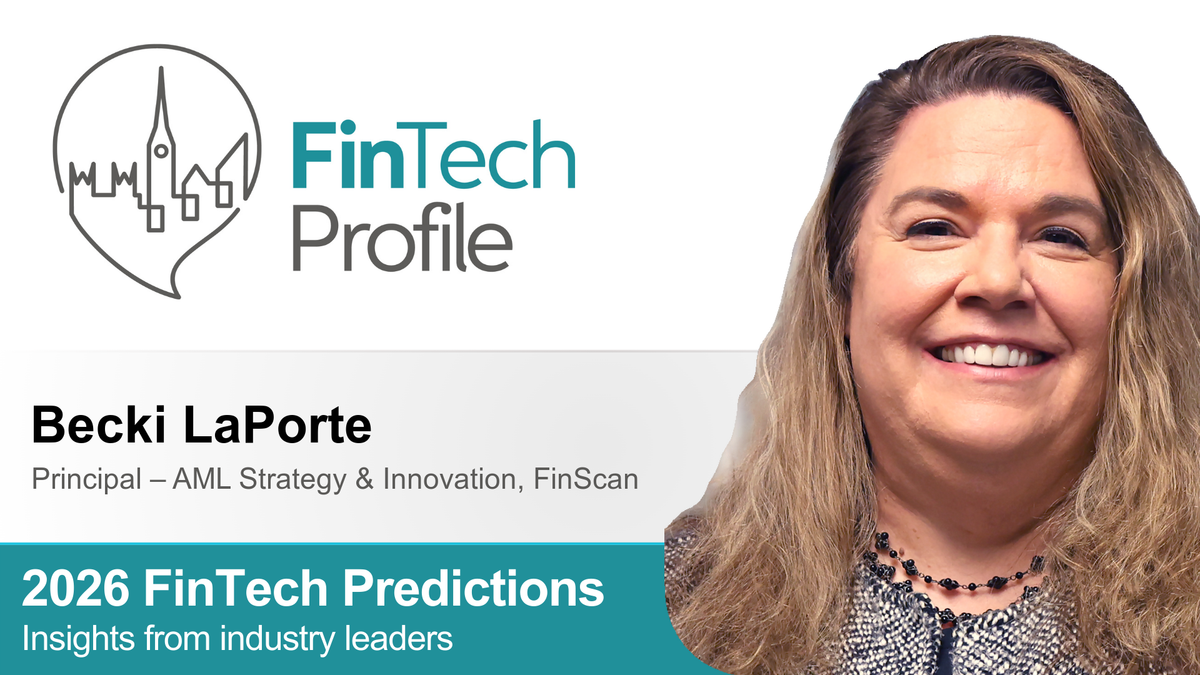
We spoke with Becki LaPorte, Principal – AML Strategy & Innovation at FinScan, an Innovative Systems solution, about the shifts she expects across financial services in 2026. With decades of experience in AML compliance technology and data management, Becki shares her perspective on the growing divide between criminals' rapid adoption of AI and the financial sector's cautious approach to implementation.
Over to you Becki - my questions are in bold:
What's the biggest shift you expect across financial services in 2026?
Technology is going to continue to evolve. As those changes occur, financial services will need to adapt and do so rapidly. Artificial intelligence (AI) has been around for several years, and many financial institutions are still having discussions about whether adopting it is appropriate for them. Some have only started using it on a limited basis. However, criminals aren't having meetings about AI strategies. They are implementing it in ways that are beneficial to them right now. AI continues to become more sophisticated where it is often difficult to determine what is human generated versus what is computer-generated. This coming year is going to accelerate the usage of AI for nefarious purposes, and the financial services industry is going to have to ramp up its adoption and use cases at unprecedented levels to not fall further behind in the financial crime battle.
Which emerging technology will have the most practical impact on banks and the FinTechs that support them?
Agentic AI is about to become a significant topic of conversation in financial services. There are already use cases around agentic AI serving as level-one analysts in financial crime teams. This technology is trained to review alerts for items such as possible sanctions matches to potential suspicious activity. Alerts can be cleared rapidly without human intervention. Those that cannot be cleared by the agent are routed to a higher-level queue to be reviewed by a human being. Agentic AI is saving financial institutions time and money, and those who have embraced the technology can't imagine doing business without it. Using this technology is like having agents shop for you. Instead of going on to your favourite online store to find the items you need, the agent will do that for you. It will find what you need at the best value, order, pay, and have it shipped to you. It's like having a personal assistant at little to no additional cost. Additional use cases are likely to emerge in 2026.
What customer behaviours or expectations will most challenge banks and financial service providers?
Customers want transactions that are fast and frictionless. That isn't new, but the expectations will continue to increase as more providers enter the industry. The providers that promise and deliver on instant payments consistently will lead the pack. This may be a benchmark for solutions providers, but financial crime professionals know it to be a breeding ground for fraud. Friction and time, even if brief, often allow enough of a break to stop money from being moved as part of a scam.
Most customers don't understand the reason for extra steps prior to money movement. Many are annoyed when questioned. Their response is often to find a different provider. However, those customers are also often the first to go to the financial institution and question why they allowed them to move money as part of a fraud activity and then demand to be made whole.
In the EU, recovering customer funds from fraud may become a reality. The EU PSD3 (Payment Services Directive 3) will make banks and other PSPs responsible for reimbursing victims of APP (Authorised Push Payment) scams. This can make a significant impact on banks and PSPs, especially when questions arise regarding which entity will have to reimburse when there are several banks involved in a transaction. As a result, legislators and regulators are seeing pushback since the onus falls strictly on the financial services industry. Many of these scams start either by phone or on social media; therefore, the question arises as to why those industries aren't included in the reimbursement responsibility.
What risks or blind spots do you think the industry is underestimating as we move into 2026?
The industry should be taking a long hard look at their staffing to evaluate if they have the right people – both quantity and quality – in the right roles. Too often, the strategy is to cut headcount to save money. That occurs through not filling roles after natural attrition or investing in technology that will reduce the need for people. Sometimes it involves moving offshore simply because it's cheaper, but not because it's part of a good business strategy.
Gone are the days of entry-level compliance analysts who do very simple tasks that help build knowledge and prepare them for their next role. Technology addresses most of those basic tasks today. Companies are hiring entry-level analysts at a higher skill level where they will likely require additional training and support to understand more complex scenarios that were previously learned on the job. Most roles also now require more technology expertise than before. In addition to legacy skills for various roles, employees may need to have a good understanding of how to prompt AI solutions, for example, or they may now need a basic understanding of SQL to query data. Strong critical thinking skills are needed in nearly all levels of the compliance function but are not as easy to train as other skills. This acumen should be a key component of hiring decisions.
If you were advising a bank's leadership team today, what strategic priority should they focus on to stay competitive in 2026 and beyond?
When we hear the word "competitive", we often think revenue, profits, and innovation. All of that is true, but a lot can be said about working with or for a company that you can trust — the company that puts money into growing their business correctly. I would encourage leaders to prioritise their compliance function. Oftentimes, we talk about the tone from the top in developing a compliant organisation. Companies may have a good ethics policy and annual training, but that's where it ends. Funds are allocated elsewhere. Compliance staff can't work effectively with a skeleton crew and limited training and opportunity.
Old technology isn't catching today's crimes. Look at your compliance infrastructure. Do you have the right people? Do you have the right technology? Where do you need to invest in compliance to give your organisation the proper foundation to support growth in other areas? Expanding other functional areas while neglecting your compliance function can result in all that hard earned revenue going to pay fines and remediation. It's even harder to bounce back from the bad press that comes with it. Being solid and trustworthy can be a competitive edge in today's rapidly changing environment.
Thank you Becki! You can connect with Becki on her LinkedIn Profile and find out more about the company at https://www.finscan.com/.