
2026 FinTech Predictions: Insights from Alexon Bell of Quantexa
Quantexa's Chief Product Officer shares predictions on agentic AI, data quality challenges, and the emerging threat of deepfakes in financial services.
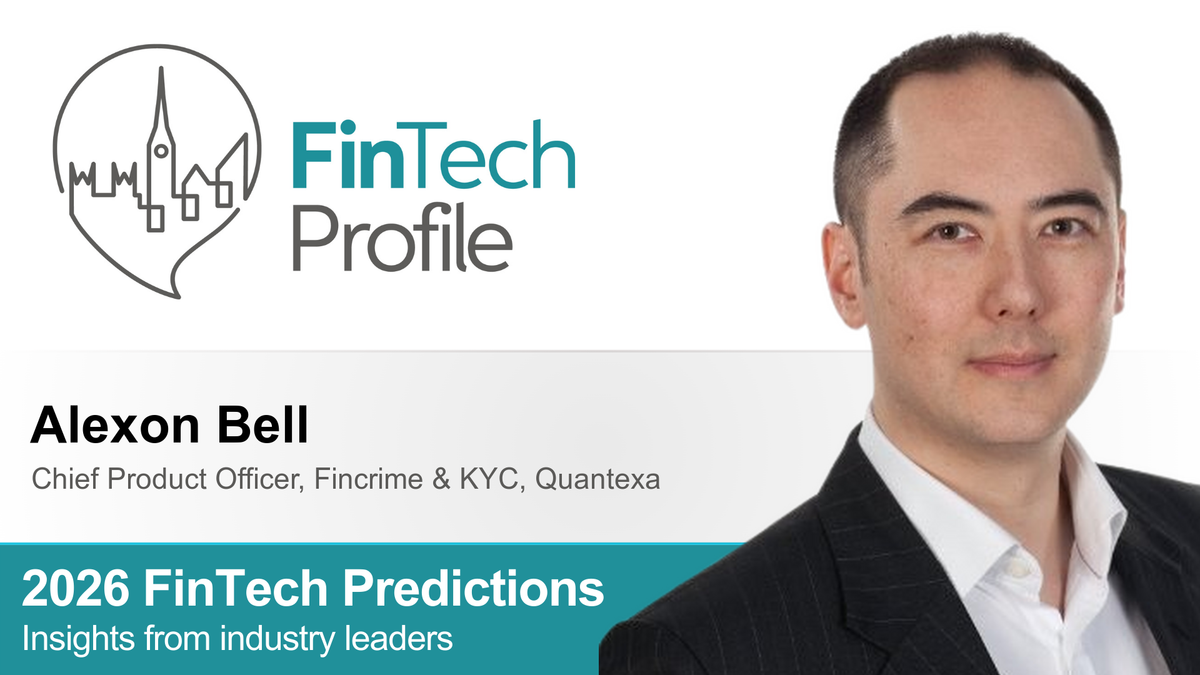
We spoke with Alexon, Chief Product Officer for Fincrime & KYC at Quantexa, a global leader in Decision Intelligence technology. With deep expertise in financial crime prevention and AI-driven decision-making, Alexon offers a compelling perspective on the technological shifts reshaping banking and financial services.
Over to you Alexon - my questions are in bold:
What's the biggest shift you expect across financial services in 2026?
Financial institutions are shifting toward AI systems that don't just generate content, but actively support decision intelligence across anti-money laundering, know your customer, fraud, credit and risk operations. Agentic AI will be transformative because it acts as a smarter orchestration engine that assembles multiple techniques to solve complex problems. Agent-based systems will increasingly handle data gathering, evidence collection, triage and multi-step analysis, freeing analysts to focus on value-driven tasks and decision making rather than admin.
Which emerging technology will have the most practical impact on banks and the FinTechs that support them?
Agentic AI will have the most transformative impact. Generative AI is the latest hype piece in the AI cycle, but agentic AI will be transformative because it acts as a smarter orchestration engine that assembles multiple techniques to solve complex problems. Right now, there is a slight lag in slower adoption of advanced techniques into regulated environments, but they are coming.
Artificial Narrow Intelligence starts to improve due to better data and learning from Gen AI. ANI will also start to interact with each other in domain, for example credit AI will encompass all facets of Credit modelling and can start to learn across them.
Incorporation on Entity aligned Unstructured data at scale will begin to enhance internal models and produce data products for enterprise consumption.
What customer behaviours or expectations will most challenge banks and financial service providers?
Deep fakes present a challenge for financial institutions, threatening banks from both internal and external fraud perspective, as criminals leverage increasingly sophisticated AI-generated content to bypass traditional security measures. The use of AI and Agentic technologies among criminal networks will significantly escalate the frequency and sophistication of scams, phishing attempts, and cyber-attacks.
What risks or blind spots do you think the industry is underestimating as we move into 2026?
AI is only as smart as the bank's worst data. In 2026, the success of decision-making across finance, from credit models and fraud to KYC risk scoring and case investigations, will rest on data quality. If an organisation's data is wrong, its AI will make the same wrong decisions, only quicker. This is a fundamental challenge that is limiting AI's impact on financial services today. A significant number of generative AI proofs-of-concept fail to make it into production, and it is simply down to data.
A lack of monitoring and "debugging" tools to test and ensure Agentic Systems are not going rouge and performing tasks they are not "entitled" to perform, especially when they inherit access privileges from users. Specific concern is the corruption of internal agentic platforms from foreign agents, which then brings down whole systems, buildings or even an enterprise.
If you were advising a bank's leadership team today, what strategic priority should they focus on to stay competitive in 2026 and beyond?
Investment needs to focus on data foundations that enable stronger, more context-aware decision-making, as without this foundation, AI will underperform regardless of how advanced the underlying model technology may be. Organisations must focus on building trust with AI where human-in-the-loop validation can happen, especially for Generative AI and Agentic AI applications, which will drive parts of the data strategy.
While it's important to think big about AI's transformational potential across the enterprise, companies should start small to build momentum and organisational familiarity with these technologies, then accelerate implementation once core competencies are established. Building strategic partnerships with vendors enables organisations to prototype solutions, fail fast when approaches don't work, and move forward with learning-driven iterations, using the learning from successful approaches to accelerate improvement.
Thank you Alexon! You can connect with Alexon on his LinkedIn Profile and find out more about the company at https://www.quantexa.com.